
READ PSALM 1. There, you’ll find a basic worldview that pervades the whole collection of poems and songs: the path of righteousness leads to God’s blessing, but the path of wickedness leads to destruction. But even people who don’t believe in God or care about the Bible have some sense that this is the way things should be. It’s what most of us are raised to believe. Do what’s right, and you’ll be rewarded. Do what’s wrong, and you’ll be punished.
Of course, things don’t always work out that way, even in the psalms. The collection is filled with laments in which the psalmist struggles to stay faithful and trust God’s faithfulness when everything seems to be going wrong. The righteous aren’t being blessed in the way they expected to be, and the wicked are doing whatever they want, unpunished and unchecked. In contemporary language, the theme of such laments is, God, what is up with that?
We expect good to be rewarded and evil to be punished—if not right now, then soon. But so much of what we read in the stories of the faithful is a waiting game: waiting for God to act, to hear our prayers, to fulfill what we’ve taken to be divine promises.
Take Abram and Sarai as an example, the faithful but childless couple who would later be renamed Abraham and Sarah. God promised Abram that he and Sarai would have a son, even though Abram was already in his seventies. God made the promise, but didn’t give Abram a timetable. So the couple waited. And waited.
And waited.
When they thought they had waited long enough, they took matters into their own hands. Sarai told Abram to sleep with her maid Hagar and fulfill the promise through her; in that way, Ishmael was born. Ishmael, of course, was not the fulfillment of the promise; their son Isaac would be. But Isaac wasn’t born until twenty-five years after the promise was made, when Abram was fully a hundred years old.
Say what you want about Abram and Sarai’s impatience. But how many of us would wait patiently for twenty-five years for God to make good on a concrete promise?
We’d probably get impatient after twenty-five days.
The story of Abraham and Sarah is foundational to the story of the Jews, and seems to be the unspoken backdrop to Luke’s story of Zechariah and Elizabeth. Here again is how Luke describes them. This time, we’ll use the Common English Bible:
During the rule of King Herod of Judea there was a priest named Zechariah who belonged to the priestly division of Abijah. His wife Elizabeth was a descendant of Aaron. They were both righteous before God, blameless in their observance of all the Lord’s commandments and regulations. They had no children because Elizabeth was unable to become pregnant and they both were very old. (Luke 1:5-7, CEB)
As a priest, Zechariah would have been a descendant (as traced through his father’s side of the family) of Aaron, the brother of Moses; a Jewish reader would take this for granted. Though there were some restrictions on whom priests were allowed to marry, they were free to marry a woman from any of the twelve tribes. It’s significant, therefore, that Elizabeth was also a descendant of Aaron. The couple had an impressive pedigree from the start.
Moreover, they lived up to that pedigree. Luke declares that both of them were “righteous before God” and completely blameless in obeying everything God commanded in the Torah. Does that mean that they never stumbled, never sinned? Is Luke saying, for example, that they never snapped at each other as husband and wife, never went to bed angry? Not necessarily. But to call them “blameless” suggests that as far as righteous living was concerned, you couldn’t have a better example than Zechariah and Elizabeth.
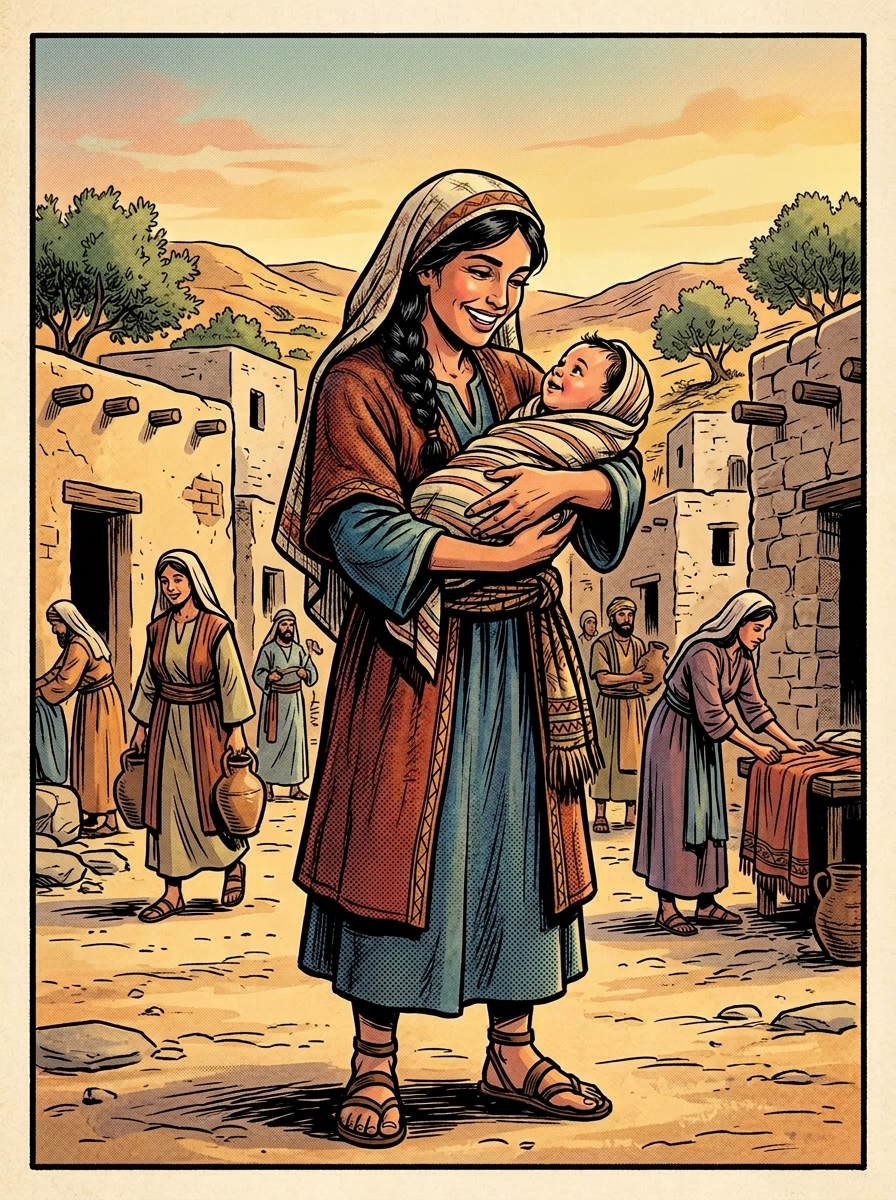
That’s what makes verse 7 surprising: if they were so righteous, why weren’t they being rewarded for it? Children were considered a blessing from God, especially sons who would carry on the family lineage. Conversely, childlessness was often considered a curse, particularly for women, for whom childbearing was one of their most important roles.
Think, for example, of the story of Jacob, Leah, and Rachel. Jacob loved Rachel and worked seven years for the privilege of marrying her. But on his wedding night, he was tricked into sleeping with her older sister, Leah, forcing him to marry Leah instead and work another seven years for Rachel. This set up an ongoing, bitter rivalry between the sisters for Jacob’s affections—a rivalry that took the form of a contest to see who could give Jacob more sons, whether by bearing the children themselves or by proxy through their maids. The feud went on for years, resulting in twelve sons.
After Leah had herself given birth to Jacob’s first four sons, Rachel was desperate. Listen to the conversation between her and Jacob:
When Rachel saw that she was not bearing Jacob any children, she became jealous of her sister. So she said to Jacob, “Give me children, or I’ll die!” Jacob became angry with her and said, “Am I in the place of God, who has kept you from having children?” (Gen 30:1-2)
Both Jacob and Rachel assume that children are the result of divine blessing. They weren’t alone in this. We might think of the story of Hannah, the mother of the prophet Samuel. Despite being portrayed as a godly woman, she is unable to have children, and the text tells us that “the LORD had closed her womb” (1 Sam 1:5-6). Eventually, through her faithful and diligent prayer, we’re told that “the LORD remembered her,” and Hannah named her son Samuel, a name which in Hebrew may mean that she had been “heard by God” (vss. 19-20).
Luke’s gospel, therefore, begins with a double ambiguity, evoking curiosity in the reader. Why does the story of Jesus begin with the story of Zechariah and Elizabeth? And why, if they’re so righteous, have they not been blessed with children? Luke describes them as “very old”; it’s late in the game to expect anything good to happen.
But that’s the point. We have to keep reading to see what will happen next.

