

DURING THE COVID-19 PANDEMIC, I was invited to preach at a church that was about an hour-and-a-half drive from my house. The church wasn’t actually holding live services; they were recording their messages to distribute online. I was thus asked to get up on the platform and act as if I were preaching to a roomful of people, with the same level of enthusiasm. If you’re a strong extravert, that may sound challenging, but to an introvert like me, it wasn’t that difficult to preach to an imaginary congregation. I moved energetically about the platform, making “eye contact” with…well, empty chairs.
And when it was all done, the tech guys in the back told me—apologetically—that for some reason they hadn’t managed to record any of it, so could I please do it again?
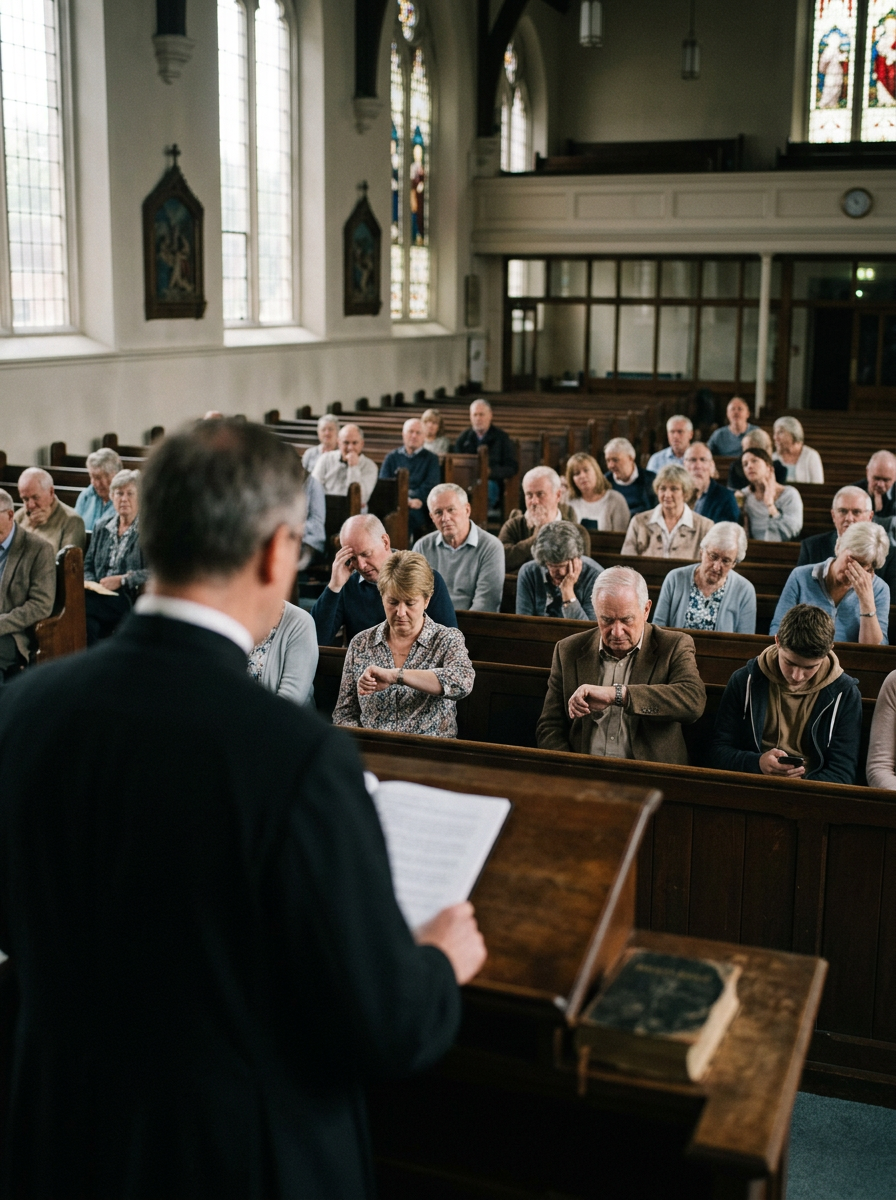
In retrospect, I suspect that there wasn’t anything wrong with the equipment. I had gone 15 minutes over my 35-minute time limit, and who wants to listen to a 50-minute sermon by a guest preacher (or for that matter, their own pastor)? Feigning technical difficulties may have been a face-saving way to try again, hoping for a shorter result from a tired preacher. It didn’t work; the second effort was just as long. At the end, they thanked me and apologized again. And not surprisingly, they never invited me back.
Depending on what we’re used to, we can get a little squirmy when a sermon goes long. People start sneaking looks at their watches, wondering when the preacher is going to wrap things up. But imagine the opposite scenario: the preacher gives a forceful 10-minute sermon and stops. People might still look at their watches, but they would be silently asking themselves a different question: “That’s it? The sermon’s over already?”
Now think about what some people consider to be the greatest sermon of all time: Jesus’ so-called “Sermon on the Mount,” as given to us in chapters 5 to 7 of the gospel of Matthew. Consider, too, its shorter cousin, the so-called “Sermon on the Plain,” found in Luke 6. If you read the two side by side, the similarities and differences pop out at you immediately. This has led people through the centuries to wonder: are we reading two versions of the same sermon, given in one place, or two sermons given in different places?
Here’s how Luke sets up the sermon:
He went down with them and stood on a level place. A large crowd of his disciples was there and a great number of people from all over Judea, from Jerusalem, and from the coastal region around Tyre and Sidon, who had come to hear him and to be healed of their diseases. Those troubled by impure spirits were cured, and the people all tried to touch him, because power was coming from him and healing them all. (Luke 6:17-19, NIV)
In some ways, the scene is similar to the one described by Matthew at the end of chapter 4 of his gospel, just before the Sermon on the Mount:
Jesus went throughout Galilee, teaching in their synagogues, proclaiming the good news of the kingdom, and healing every disease and sickness among the people. News about him spread all over Syria, and people brought to him all who were ill with various diseases, those suffering severe pain, the demon-possessed, those having seizures, and the paralyzed; and he healed them. Large crowds from Galilee, the Decapolis, Jerusalem, Judea and the region across the Jordan followed him. (Matt 4:23-25)
Both introductions mention Jesus’ ministry of teaching and healing. The latter includes the ministry of exorcism, which Luke phrases in a way that echoes his earlier story of Jesus casting out an impure spirit in the synagogue of Capernaum. Both Matthew and Luke describe large crowds of people coming to Jesus not only from Galilee but the surrounding areas, including Jerusalem itself. Notably, Luke mentions Tyre and Sidon, cities north of Galilee on the Mediterranean coast, which may suggest the presence of Gentiles in the audience.
Luke also mentions that the people in the crowd wanted to touch Jesus, “because power was coming from him and healing them all.” We might think here of the desperate woman who had suffered a bleeding disorder for twelve years and had found no help; the story will come later in chapter 8 of Luke’s gospel. Luke describes her as being healed as soon as she touched the edge of Jesus’ cloak, and in that moment, Jesus was aware that healing power had gone out from him.
Was that what the woman had hoped would happen? What Luke describes here in chapter 6 is that the news of Jesus’ healing power was already widespread, with some believing that all they had to do was touch him to be healed. One imagines that some of the folks in the crowd were only interested in being healed, and didn’t care much about becoming disciples. But as we’ll see later, Jesus seems to meet even the smallest demonstrations of faith with grace.
The two introductions in Matthew and Luke, therefore, allow for the possibility that we’re being given two versions of one sermon. But wait: why is one called the Sermon on the Mount, and the other the Sermon on the Plain? The former gets its name from one statement in Matthew: “Now when Jesus saw the crowds, he went up on a mountainside and sat down” (Matt 5:1). Similarly, the latter gets its name from one statement in Luke: he went down with his newly chosen apostles and “stood in a level place.”
Realistically, that’s not a lot to go on to say anything definitive about the location. It could very well have been two locations, with Jesus giving similar messages on two separate occasions (you preachers out there, raise your hand if you’ve ever given the same sermon twice). Or, it could have been one location, with the crowds remaining on a more level place while Jesus paused his healing ministry and walked uphill to somewhere where he could be seen and heard by everyone as he preached. There’s no way to know.
But even if it is the same sermon, it’s clear that neither Luke nor Matthew is giving us the whole sermon. Indeed, if you were to read the Sermon on the Plain out loud like a preacher, it would probably take you less than five minutes. It’s hard for me to imagine that Jesus would only have preached for five minutes to a crowd like that.
I like to think that he went at least 15 minutes over, and that they hung on every word.

