

THE GOSPEL OF LUKE is not just the story of Jesus, but of God the Father and the Holy Spirit as well. Indeed, thus far, the Holy Spirit has played a prominent role throughout the narrative, and will continue to do so all the way through the book of Acts.
Think back, for example, to the appearance of the angel Gabriel to Mary. When Gabriel told her that she would become pregnant and give birth to a son, she was at first confused. “How will this be,” she asked, “since I am a virgin?” (Luke 1:34, NIV). Luke gives us Gabriel’s answer in the next verse:
The angel answered, “The Holy Spirit will come on you, and the power of the Most High will overshadow you. So the holy one to be born will be called the Son of God.” (vs. 35)
Later, after the child was born, Joseph and Mary brought him to the Jerusalem temple, where they would meet a devout man named Simeon. How devout? The Holy Spirit is named in association with Simeon three times in three verses (2:25-27). First, we’re told that the Holy Spirit was on Simeon; then that the Spirit had revealed to him that he would get to see the Messiah before he died; then that the Spirit moved him to enter the temple courts at just the right time to have that promise fulfilled. It is by the Spirit’s direction, therefore, that Simeon took the baby in his arms and praised God, declaring to the amazement of Joseph and Mary that this child would be “a light for revelation to the Gentiles, and the glory of [God’s] people Israel” (vs. 32).
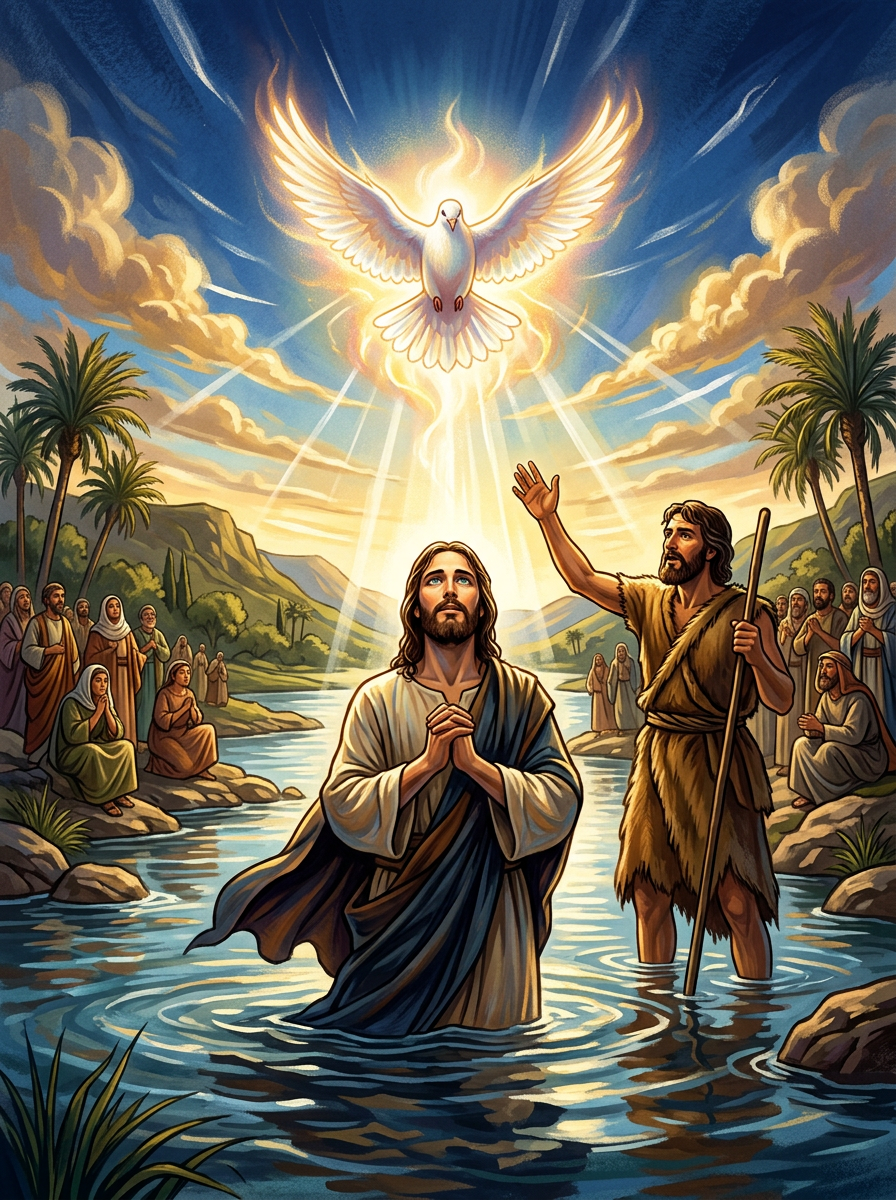
Later still, when Jesus was baptized in the Jordan by John, the heavens opened and “the Holy Spirit descended on him in bodily form like a dove” (3:22). That’s why Luke can tell us immediately after that Jesus was full of the Holy Spirit when he was led by the Spirit into the wilderness to be tested (4:1-2). Jesus, both the son of Adam and the Son of God, passed the test. Committed to doing things the Father’s way, he was ready to begin the ministry for which he had been born.
Given this way of telling the story, it should be no surprise that Luke then associates the beginning of Jesus’ public ministry with the Holy Spirit as well:
Jesus returned to Galilee in the power of the Spirit, and news about him spread through the whole countryside. He was teaching in their synagogues, and everyone praised him. (Luke 4:14-15, NIV)
Where was Galilee? On a modern-day map, Galilee would be the region in Israel north of the West Bank and across the Sea of Galilee and the Jordan River from the Golan Heights to the east. Jesus’ hometown of Nazareth would have been in Lower Galilee and situated roughly 15 miles west of the southern tip of the Sea of Galilee. According to Matthew, after successfully fending off Satan’s attempts at manipulation in the wilderness, and then hearing of the imprisonment of John the Baptist, Jesus left Nazareth to live in Capernaum, a town on the northern shore of the Sea of Galilee (Matt 4:13). Capernaum, apparently, became his base of operations for his Galilean ministry.
This part of Luke’s gospel is firmly situated in Galilee, a well-populated region known for its fertile soil and fishing trade. In the early chapters of Luke, Jesus doesn’t go to Jerusalem; the city is only mentioned when people come from there to seek out Jesus. By contrast, the gospel of John places Jesus in Jerusalem at different points throughout his ministry; not surprisingly, it seems to have been his habit to attend the required festivals.
Luke, however, doesn’t tell the story that way. He doesn’t deny that Jesus was in Jerusalem, but chooses and then arranges his materials in a way that heightens the drama. Jesus first ministers throughout Galilee, then, after the Transfiguration, makes a firm decision in chapter 9 to go to Jerusalem to complete his mission and meet his fate. This so-called “travel narrative” takes up nearly a third of the gospel, culminating with his Triumphal Entry into Jerusalem in chapter 19, where the final week before his crucifixion unfolds.
For now, here in chapter 4, Luke kicks off the narrative of Jesus’ Galilean ministry with a description of his early popularity among the people. He had gone to the Jordan wilderness to be baptized by John and receive the Spirit; in the Spirit, he had bested Satan; and again in the power of the Spirit, he returned from the Jordan to the region of Galilee.
There, he began teaching in the synagogues. We don’t know all the details we would like about synagogue practices in the first century, but suffice it to say that Luke isn’t describing what we would think of as having a guest preacher in the pulpit. There was probably a reading from the Torah, and one from the Prophets. A synagogue ruler could choose anyone from among the people in attendance to read a passage or even the deliver the sermon that followed. Luke tells us that news about Jesus had already spread throughout the surrounding region, so I imagine that the more his reputation grew, the more likely he was to be asked to read the Scriptures and expound on them.
And don’t forget: Jesus was already wowing the people—and even teachers!—with his understanding of Scripture at the age of twelve.
As a result, “everyone praised him.” I imagine the buzz in a synagogue where Jesus showed up and was recognized. Is he going to preach this morning? I wonder what he’s going to say?
It’s an auspicious beginning, one that might lead us to expect great things. But we as readers also know how Simeon warned Mary of dark things to come. Ministering in the power of the Spirit won’t save Jesus from opposition. And unfortunately, that opposition will begin in his hometown of Nazareth.

