

LEARNING A NEW LANGUAGE can be challenging. A couple of years ago, for various reasons, I decided to start learning Spanish using the Duolingo app. I’ve experienced firsthand something that I really only knew in theory: that understanding what someone says in a language versus speaking the language myself depend on different parts of the brain. In my head, I can hear a sentence in Spanish and translate it into English much more easily than the other way around; it’s much harder for me to translate from English into spoken Spanish.
And I’m reminded over and over that words have multiple meanings. At first, when I learn new vocabulary, it feels like each word in Spanish should have only one meaning in English. When I later encounter another meaning, I’m mildly annoyed, as if someone pulled a fast one. But then I remember that all languages are like that, including English. Words have multiple meanings, and to understand them, you have to rely on how they’re used in the context of the words surrounding them.
So it is with New Testament Greek. An important example is the word for temptation, which can also be translated as “trial” or “test.” Luke tells us that Jesus was led into the wilderness by the Holy Spirit, and there he was tempted by the devil. But doesn’t Jesus himself teach his disciples to pray that God would not lead them into temptation (Matt 6:13)? Of course, Luke doesn’t say that God led Jesus into the wilderness specifically to be tempted, but Matthew does (Matt 4:1). Would God really do such a thing?
The apostle James would clearly say no:
When tempted, no one should say, “God is tempting me.” For God cannot be tempted by evil, nor does he tempt anyone; but each person is tempted when they are dragged away by their own evil desire and enticed. (James 1:13-14, NIV)
But the word for temptation here also appears earlier in vs. 2, when James teaches that as believers we should rejoice when we face “trials” in life, because these help us grow in faith and endurance. The lesson, therefore, is that while God does not tempt people to evil, he does allow their faith to be tested by difficult circumstances. I’m reminded here of the story of Abraham in Genesis 22, in which God tests Abraham by asking him to sacrifice his beloved son Isaac. He only does this, apparently, because Abraham is going to be the father of an entire nation, making it incredibly important that the nation be built on as faithful a foundation as possible.
Thus, while we can legitimately say that Satan “tempted” Jesus in the wilderness, we should also say that Jesus was led there to be “tested”—to undergo a trial of faith before beginning his public ministry. And needless to say, he passed the test, much to the disappointment of the devil.
. . .
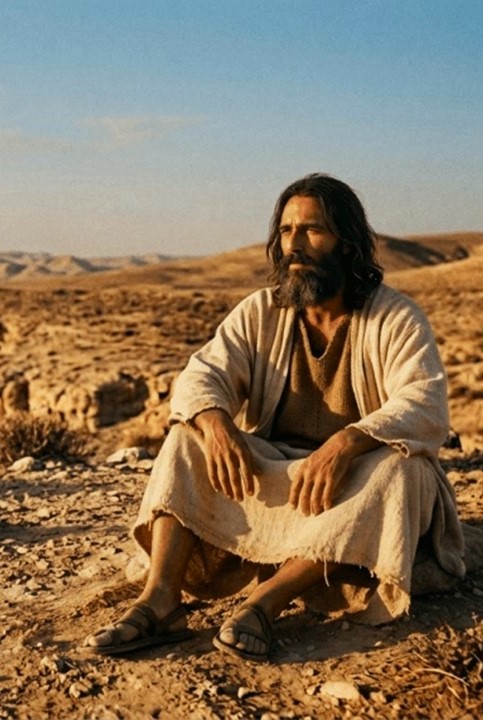
IN THE PREVIOUS POST, we set the story of Jesus’ testing and temptation against the background of the story of the Israelites and their faithlessness in the wilderness: their grumbling and complaining about bread, their refusal to take the step of faith needed to enter the Promised Land. Would the son of Adam do better?
Yes. Even when faint from hunger, he refused to use his God-given powers to serve his own personal needs, and chose to trust God instead.
The second and third temptations yield a similar result. Interestingly, Luke presents these two temptations in a reverse order compared to Matthew, which again highlights the fact that Luke’s storytelling doesn’t have to follow a strict chronological sequence. Both Matthew and Luke present the same three temptations, and do so independently of Mark, even if the order is different.
Here’s how Luke describes the second temptation:
The devil led him up to a high place and showed him in an instant all the kingdoms of the world. And he said to him, “I will give you all their authority and splendor; it has been given to me, and I can give it to anyone I want to. If you worship me, it will all be yours.” (Luke 4:5-7)
Luke doesn’t say what this “high place” is; Matthew describes it as a mountain. What’s more important is that Luke says that the devil showed Jesus all the kingdoms “of the world.” The word can refer to the entire inhabited globe. More narrowly, it was used to refer to the Roman world, as opposed to all the barbarian riffraff outside the empire. It’s the word Luke uses in 2:1, to refer to the census that Augustus ordered to be taken of the “entire world,” which the New International Version translates as the “entire Roman world.” The emperor may think the world and its splendor belongs to him; but here, Luke tells us that it actually belongs to devil.
Does he really mean that? Some interpreters say yes, others say no, and it has to be admitted that Jesus doesn’t dispute the claim. But he doesn’t need to argue the point with Satan, because that’s not where the core of the temptation lies. Jesus would soon begin preaching about the kingdom of God (Luke 4:43), and his mission of bringing that kingdom would include his death on the cross. But Satan was offering him a shortcut to a different kind of kingdom with a different kind of glory. Jesus didn’t have to do things God’s way. He could have the whole world and all of its glitz right now if he would do one simple thing: choose to worship the devil, to submit to his authority, instead of the Father’s.
Jesus’ response was categorical and, I imagine, swift:
Jesus answered, “It is written: ‘Worship the Lord your God and serve him only.’” (Luke 4:8)
Again, it’s an echo of Moses’ sermon to the Israelites as they prepared to enter the Promised Land: “Fear the LORD your God, serve him only and take your oaths in his name” (Deut 6:13). That verse is just a few sentences after a more famous command: “Hear, O Israel: The LORD our God, the LORD is one. Love the LORD your God with all your heart and with all your soul and with all your strength” (vss. 4-5).
These were commands that the Israelites, in the years leading up to the exile, forgot. They routinely turned to the idols of other nations and suffered the consequences.
But here at the outset of his mission, the Messiah, the son of Adam, the son of God, would do differently. He rejected the opportunity to inherit all the glory of this world by submitting to the will of Satan. He would do his Father’s will instead, and only his Father’s will. And in so doing, he made it possible for us to inherit the kingdom of God.

