
LET’S GO BACK again to the story of the ancient Israelites in the wilderness. Through God’s miraculous intervention, they escaped slavery and Pharaoh’s mighty army. The story is told in Exodus 14, and in Exodus 15, Moses leads the Israelites in joyous song. But by the end of that very chapter, the people had already begun grumbling for water. God graciously provided. In the next chapter, chapter 16, they grumbled for food, and again, God provided.
Guess what happened in the chapter after that?
Right: the people grumbled some more, this time again for water. They actually dared to say to Moses, “Why did you bring us up out of Egypt to make us and our children and livestock die of thirst?” (Exod 17:3, NIV). Exasperated, Moses cried out to God, “What am I to do with these people? They are almost ready to stone me” (vs. 4). Think about that for a moment. It was by Moses’ hand that God had freed the people from the Egyptians, and now they’re ready to stone him?
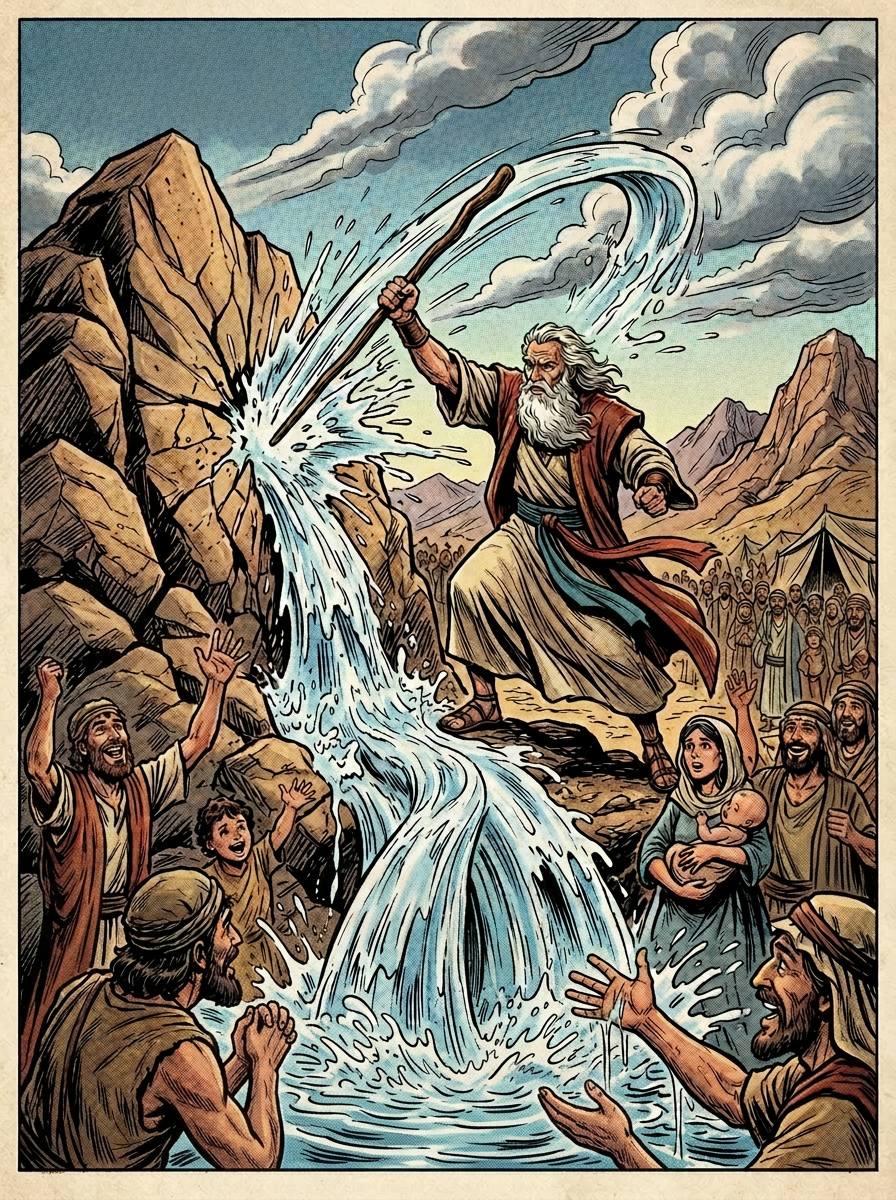
Again God provided. At God’s direction, Moses struck a rock with his staff, and water gushed forth for the people. We’re told that Moses named the place Massah and Meribah, words than mean “testing” and “quarreling,” because the people “tested the LORD, saying, ‘Is the LORD among us or not?'” (vs. 7). God had parted the sea for them, and then in the wilderness, made bitter water sweet enough to drink, and given them all the manna and quail they needed. And still they wondered aloud whether God was really with them.
Decades later, therefore, as the people prepared for their second chance to enter the Promised Land, Moses urged them to remain faithful, warning, “Do not put the LORD your God to the test as you did at Massah” (Deut 6:16).
These, then, are the words Jesus quotes in response to the devil’s third and last bid to turn him from God’s way (in Matthew, it’s the second of three). Here’s how Luke describes the temptation:
The devil led him to Jerusalem and had him stand on the highest point of the temple. “If you are the Son of God,” he said, “throw yourself down from here. For it is written: ‘He will command his angels concerning you to guard you carefully; they will lift you up in their hands, so that you will not strike your foot against a stone.’” (Luke 4:9-11, NIV)
As some have suggested, it’s possible that this temptation and the one before came to Jesus in a vision, though neither Luke nor Matthew say this. There is no “high place” or mountain, after all, where one would be able to see all the kingdoms of the world “in an instant,” as the New International Version translates it (vs. 5). And it would have been quite the spectacle for Jesus to be seen standing at the highest point of the temple. He would have been the talk of Jerusalem, unless this was somehow done when no one was around to see.
The story makes it seem as if Satan has learned a thing or two from debating with Jesus. In both of the prior temptations, Jesus responded by quoting Scripture. This time, therefore, the devil himself quotes Scripture. The passage in question is from Psalm 91, a poem expressing deep trust in God as the psalmist’s refuge. Here’s the verse Satan quotes, in context:
If you say, “The LORD is my refuge,”
and you make the Most High your dwelling,
no harm will overtake you,
no disaster will come near your tent.
For he will command his angels concerning you
to guard you in all your ways;
they will lift you up in their hands,
so that you will not strike your foot against a stone.
You will tread on the lion and the cobra;
you will trample the great lion and the serpent. (Ps 91:9-13)
Notice the difference: where the psalmist says that God will command his angels to “guard you in all your ways,” Satan’s wording is that the angels will “guard you carefully.” The difference is small but significant. When the psalmist teaches that God will guard the ways of the faithful, it’s a broad promise of providence and blessing such as that found in Psalm 1, which encourages us to believe that “the LORD watches over the way of the righteous” (vs. 6). It is not a blanket promise that God will protect us no matter what, even when we do something abysmally stupid or disobedient.
Moreover, the reference to striking our feet against stones, especially in the context of the word “way,” is probably meant to be an image of walking in a place where the path is strewn with obstacles over which we might trip. It’s quite a stretch to go from “God will keep you from stumbling as you follow the way” to “Throw yourself down from a high place and you won’t hit the ground.”
But unfortunately, that’s how we sometimes want to read Scripture. We ransack the text for so-called “promises” that would be for our benefit and hold God to them. We take the Bible to be saying what we want it to say rather than what it actually says, often by ripping single verses completely out of context.
That’s one reason why Jesus’ response to the devil is so important for us:
Jesus answered, “It is said: ‘Do not put the Lord your God to the test.’” When the devil had finished all this tempting, he left him until an opportune time. (Luke 4:12-13)
Jesus knows that throwing himself from the temple wouldn’t be an act of faith; it would be an ill-conceived test of God’s faithfulness, in same vein as the Israelites’ complaint in the wilderness: “Is the LORD among us or not?”
One also has to wonder: if Satan already had Jesus in a high place during the second temptation, why not just tell him to throw himself down from there? Wouldn’t that serve the purpose?
It wouldn’t—not if by taunting Jesus with the words “If you are God’s Son” for a second time he was tempting him to take a shortcut to proving that he was the Messiah. Again, imagine the spectacle: Jesus standing in a holy place of worship where everyone could see, capturing everyone’s breathless attention as he took a swan dive from the highest point of the temple, landing softly and gracefully on his feet.
Today, the video would go viral in an hour.
But that wasn’t the Father’s way, and therefore would not be the Son’s way either. As the Son of God, he had nothing to prove and would not put the Father to the test. Satan’s gambit failed, and he departed in defeat.
So with that story in mind, let’s ask ourselves: have we ever thought, “If God is really God, then he’ll do this or that for me”? Maybe he will, and maybe he won’t. But to ask if God is really God is a dangerous path to walk.
And don’t forget: even the devil can quote Scripture.

