
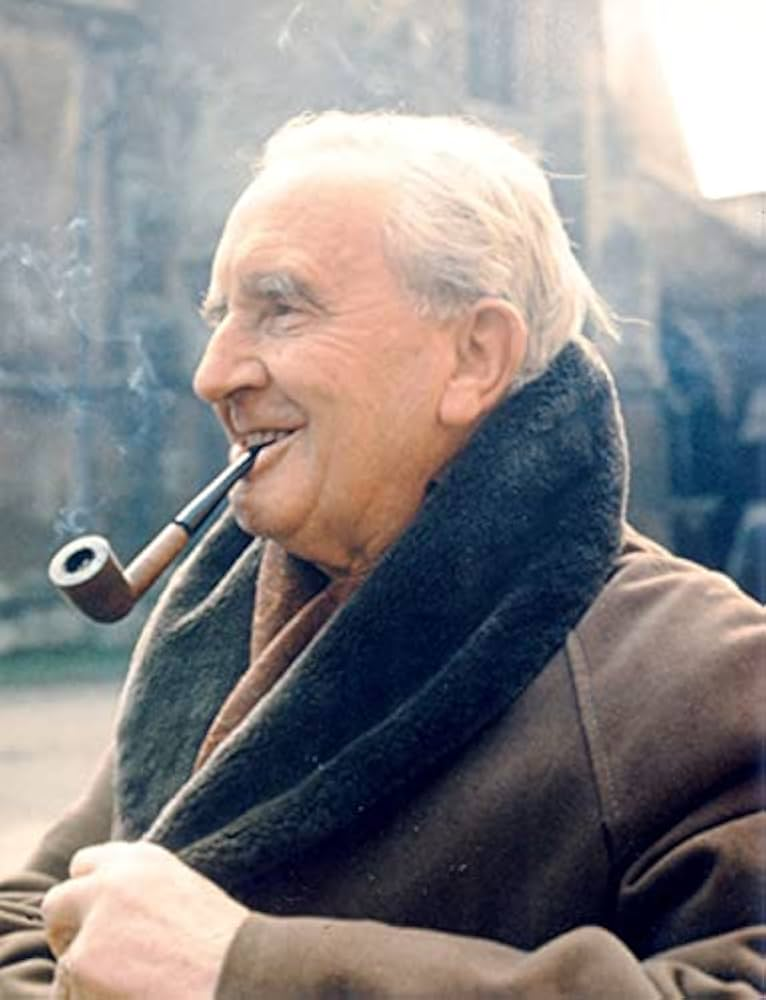
I FIRST READ J. R. R. Tolkien’s The Lord of the Rings fantasy trilogy in the late 1960s, as a teen or preteen. It was originally published in the mid-50s, but wasn’t released in the United States as a mass-market paperback until 1965. My older sister had heard about them and used her allowance to buy copies for herself.
Curious, I borrowed The Fellowship of the Ring from her and started reading it in the evening; once I started, I was reluctant to put the book down. I don’t remember exactly, but I suspect that reading soon became a higher priority than schoolwork. At the very least, I’m sure I would have rushed through my homework to flop down on the bed once more, book in hand; I longed to re-immerse myself in the make-believe world of Middle Earth and join Frodo the hobbit and his companions in their quest to defeat evil.
Later, in college, I got my wife-to-be hooked on the novels; later still, we made our children fans of Middle-Earth, too. And recently, in the evenings, my wife and I began listening to the audiobook version of the trilogy, narrated by Andy Serkis (best known for portraying the creature Gollum in the highly successful trio of films). Serkis is absolutely marvelous; he doesn’t simply read the books, he energetically performs them, bringing a distinct voice to each character.
That tour-de-force reading includes his performance of what to modern readers may be the oddest thing about Tolkien’s trilogy: the songs.
As in any epic quest, the heroes are in constant danger, whether from men, or magic, or monsters. But every so often, one of them will break out in song. Tolkien, of course, wasn’t writing a musical; he was trying to convey what it would be like to live in an oral society in which the heroic deeds of old were to be honored forever in song and legend; that’s how a people’s moral vision was passed from one generation to the next. Some of the songs in the book are even sung in languages Tolkien himself created, and many of the lyrics are left untranslated. He wanted the songs to have an air of ancient mystery about them, making Middle Earth seem more like a real place with its own long and storied history.
Luke isn’t writing a musical either, but much of the first chapter of his gospel is devoted to songs of praise, first by Mary, then by Zechariah. The songs may seem unnecessary; if you read the chapter with these verses taken out, it flows as a continuous narrative. In verse 45, for example, we would have Elizabeth finishing her prophetic words to Mary: “Blessed is she who has believed that the Lord would fulfill his promises to her”(NIV). The next verse would then be: “Mary stayed with Elizabeth for about three months and then returned home” (vs. 56). That makes perfect sense.
But actually, in-between these verses, we have Mary’s song, known in church tradition as the Magnificat:
My soul glorifies the Lord
and my spirit rejoices in God my Savior,
for he has been mindful
of the humble state of his servant.
From now on all generations will call me blessed,
for the Mighty One has done great things for me—
holy is his name.
His mercy extends to those who fear him,
from generation to generation.
He has performed mighty deeds with his arm;
he has scattered those who are proud in their inmost thoughts.
He has brought down rulers from their thrones
but has lifted up the humble.
He has filled the hungry with good things
but has sent the rich away empty.
He has helped his servant Israel,
remembering to be merciful
to Abraham and his descendants forever,
just as he promised our ancestors. (vss. 46-55)
In Tolkien’s novels, the songs sketch a rich history that resides in the memory and imagination of the characters, forming a narrative backdrop for the decisions they must make in their own quests, whether to fight or flee, go on or turn back. In her song, similarly, Mary locates her own story firmly inside the ancient story of the God of Israel and his covenant faithfulness to his people; that fits well with Luke’s purposes for the gospel as a whole. It’s not just about what God has done for Mary personally; it’s about what God has always done, because of who God is. Her song portrays God as a mighty warrior who on the one hand defeats powerful kings, but on the other hand has compassion on the powerless. We can even hear distinct echoes of the Psalms in her words.
And we should also remember the other songs of Scripture, sung in response to the mighty acts of God on behalf of his people. Think back, for example, to the drama of the Exodus. After the Israelites cross the Red Sea and look back to see their enemies lying dead on the far shore, they sensibly fear God—and then Moses leads them in song. The song begins by memorializing the event:
I will sing to the LORD,
for he is highly exalted.
Both horse and driver
he has hurled into the sea. (Exod 15:1)
Similarly, in verse 4 we read:
Pharaoh’s chariots and his army
he has hurled into the sea.
The best of Pharaoh’s officers
are drowned in the Red Sea.
Much of the rest of the song, however, moves outward from the event to praise God as a majestic and powerful warrior, a king who will defeat enemy nations and reign forever. Thus, on one level, the song celebrates God’s miraculous rescue of his people—but on another, it praises the faithful and mighty character of God and serves notice on those who would oppose him and his people.
Mary’s song follows in this lyric tradition. And indeed, as we’ll see shortly, her song bears some striking similarities to one sung by another mother who miraculously gave birth to a son: the song of Hannah, the mother of the prophet Samuel.

