
OF ALL THE SONGS that play on Christian radio during the Christmas season, one of the most moving is Mary, Did You Know? as performed acapella by Pentatonix. Their seamless harmonies make the song hauntingly beautiful, spurring me to imagine what it could have been like to be young Mary, thrust so unexpectedly into the role of being the mother of the long-awaited Messiah, on whom thousands of people had pinned their hopes, generation after generation. “Mary, did you know,” the lyrics ask, that “this child that you delivered will soon deliver you?” Or, “Mary, did you know that…when you kiss your little baby, you kiss the face of God?”
Who would this child of hers grow up to be? The angel Gabriel had told her, and she believed, even if she didn’t understand everything that was happening or would happen. Her relative Elizabeth had told her, and she responded with a song of joy. The shepherds had told her, and she pondered what they had said.
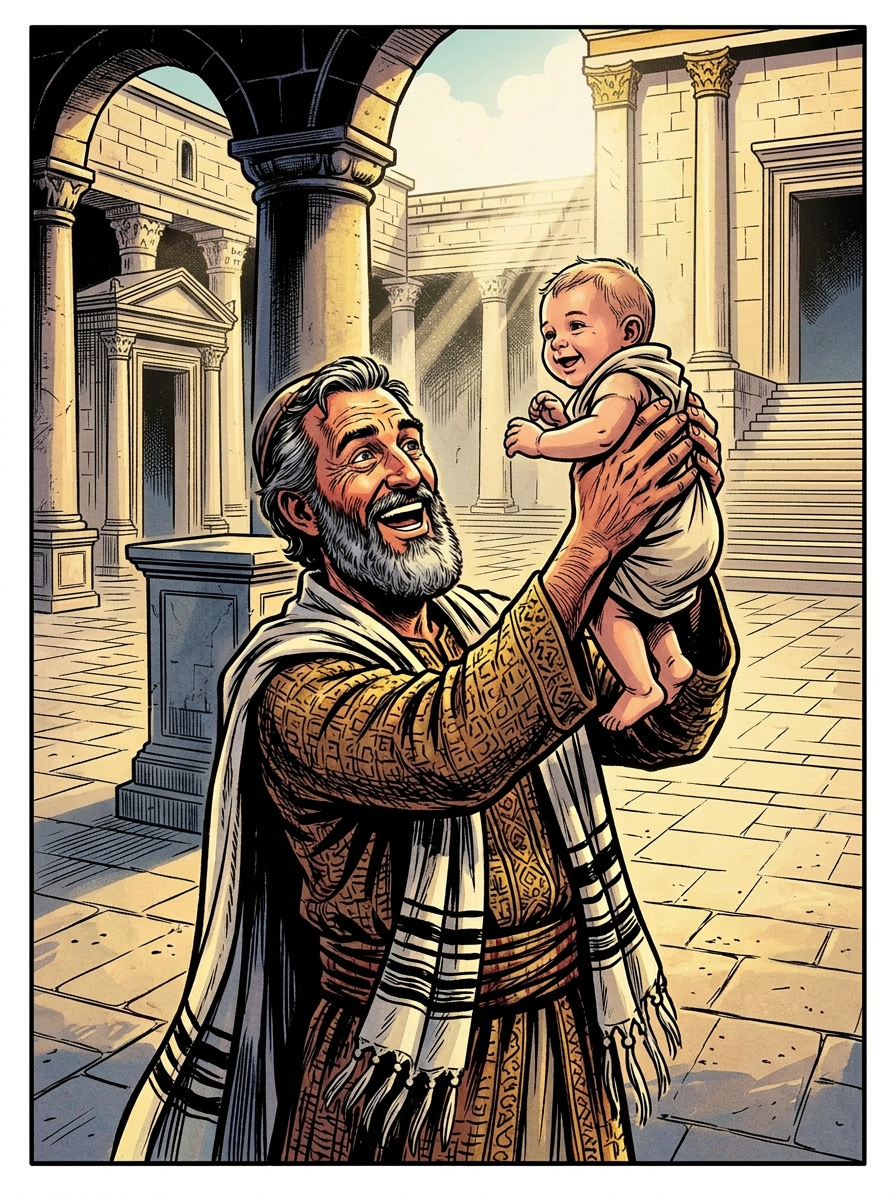
And now, as she and Joseph come to the Jerusalem temple to present their baby, a stranger named Simeon scoops him up and begins to prophesy over him.
I don’t know about you, but if a stranger tried to take my kid from my arms, I would automatically and warily pull back. Luke doesn’t tell us if Simeon tried to reassure the parents first: No, no, it’s okay, really! I have a word for you from God! But I imagine them having to be open to anything God might do. Luke doesn’t just say that they “brought” Jesus to the temple. Rather, they came to “present” him; the language may be an echo of the story of Hannah, who had dedicated her son Samuel to God. Given everything that had happened so far, Joseph and Mary knew that the child wasn’t just theirs.
Here’s what Luke tells us about Simeon:
Now there was a man in Jerusalem called Simeon, who was righteous and devout. He was waiting for the consolation of Israel, and the Holy Spirit was on him. It had been revealed to him by the Holy Spirit that he would not die before he had seen the Lord’s Messiah. Moved by the Spirit, he went into the temple courts. When the parents brought in the child Jesus to do for him what the custom of the Law required, Simeon took him in his arms and praised God… (Luke 2:25-28, NIV)
There’s hardly more that Luke could say to mark Simeon as a man of faith and a reliable witness. He is “righteous and devout”; he has the gift of the Holy Spirit and goes where the Spirit leads. Simeon has been waiting, presumably for a long time, for the “consolation of Israel,” the time in which God would send his Messiah to free the people from their long history of foreign oppression. Indeed, through the Spirit, God promised Simeon that he would see the Messiah before he died.
Led by the Spirit, he entered the temple, saw Mary, Joseph, and the baby and knew that God had kept his word. Taking the baby in his arms, he sang these words:
Sovereign Lord, as you have promised,
you may now dismiss your servant in peace.
For my eyes have seen your salvation,
which you have prepared in the sight of all nations:
a light for revelation to the Gentiles,
and the glory of your people Israel. (vss. 29-32)
I imagine Simeon having tears of joy streaming down his face as he sings this so-called “Song of Simeon,” otherwise traditionally known as the Nunc Dimittis, which is Latin for “now dismiss.” His heart’s desire has finally been fulfilled. Luke doesn’t specifically say it, but for Simeon to tell God “You may now dismiss your servant in peace” suggests that Simeon was probably quite old and ready to die a happy man.
The New International Version changes up the order of Luke’s words. A more literal translation of the song would begin, “Now, dismiss your servant, Master.” That way of saying it puts the emphasis on the word “now,” as if to say, “Finally!” or “At long last—you can let me go!” It also underscores the contrast between Simeon as God’s “servant,” and God as his “master,” his absolute ruler. It’s not the usual word that’s typically translated as “Lord”; this is the only place the word appears anywhere in the four gospels. It highlights once again the man’s devotion, the faith that kept him longing to see the prophesied Messiah for so long.
Those familiar with the prophecies of old might have heard echoes of Isaiah in Simeon’s song. In Isaiah 49:6, God tells his Servant, “I will also make you a light for the Gentiles, that my salvation may reach to the ends of the earth.” For Simeon to suggest that the coming of the Messiah was for the glory of the people of Israel would have surprised no one. But the Gentiles? True, the prophecy doesn’t specifically say that salvation would be for the Gentiles, just light. But how else should we understand the vision of salvation reaching “to the ends of the earth”? Having been a companion of the apostle Paul, having had a hand in Paul’s evangelistic work among the Gentiles, Luke tells the story to a Gentile, with the benefit of hindsight.
As I mentioned near the beginning of our study, it’s significant that Luke will later recount the story of Jesus reading from the scroll of Isaiah in the synagogue of his hometown of Nazareth. In so doing, he proclaims the good news of God’s favor, and the congregation is suitably impressed and encouraged. But when he goes on to suggest that the people are taking too much for granted and that salvation might be for the Gentiles as well, they run him out of town.
Jesus, in other words, would be hated by many for suggesting what Isaiah had already said centuries before, what Simeon sang so joyfully in the temple. Mary, did you know? Because Simeon has more to say on the subject.

