
TO ME, PERSONALLY, it was a miracle. Not the kind that suspends what we would call the laws of physics or nature. No storms were stilled; no one was healed or raised from the dead. It was a more ordinary kind of miracle, the kind in which you know you’ve been rescued in a way that’s technically possible but so highly improbable that you have to see it as the hand of God.
My wife and I were on our way to a birthday party for a boy who had just turned one or maybe two; I don’t remember which. The parents were friends of ours from our grad student days, and other mutual friends would be there too. We all started having kids around the same time.
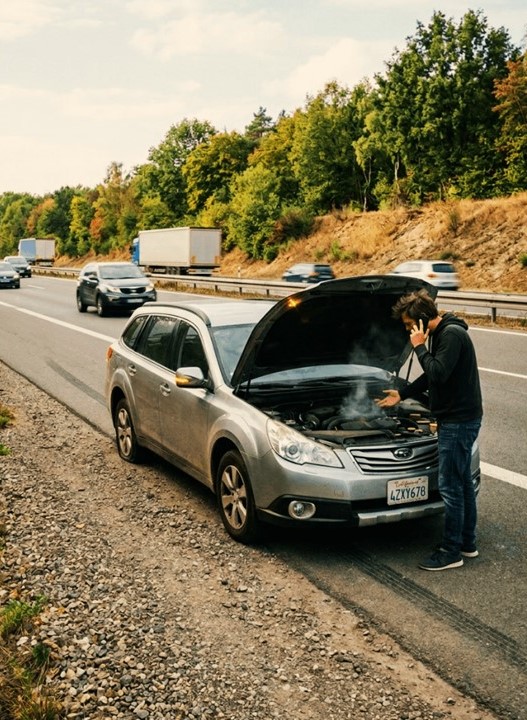
I was driving and my wife was riding shotgun; our two kids were strapped into their car seats in the back. Suddenly, at full speed on the freeway, the engine started to buck and splutter; we couldn’t do more than a crawl without the engine threatening to stall. I found out later that our fuel pump had failed and needed to be replaced.
I didn’t want to stall out on a busy freeway with my kids in the car. We limped to the next exit and got off the freeway and out of traffic. But we were also out in the middle of nowhere, in the days before cellphones. To call for help, I would have to walk back up the offramp and onto the freeway, choose a direction, and hope to find an emergency callbox nearby. And to do that, I’d have to leave my wife and kids behind in a place that didn’t feel safe. I felt torn and didn’t know what to do.
We debated for a while before another car exited the freeway and pulled up behind us. I automatically tensed as the driver got out, not knowing what to expect.
But I was flooded with relief, gratitude, and then wonder when I saw who it was. It was our other friends, who were en route to the same birthday party.
Mind you, we had left our respective homes later than we had planned, so nobody was on schedule—and their house was thirty miles west of us. Yet somehow, they ended up behind us on the same stretch of freeway, close enough to see us and recognize our car. They were in just the right place at just the right time.
Had they seen us for a while? Looking back, I don’t think so, or they would have gotten off the freeway with us. Rather, they saw and recognized us in that brief window of time—no more than seconds long—when we pulled off and disappeared from sight as they sailed past the exit. They knew we were in trouble, so got off the freeway as soon as possible and circled back to find us. We all crammed into their small car, kids sitting illegally in laps as they drove us home for me to call the auto club. Long story short, I never made it to the party that day. But I’ve never forgotten what felt like a miraculous act of mercy on God’s part, delivered through loving friends.
Was it mere coincidence? It’s possible. But as the gospel of Luke suggests, God seems fond of orchestrating such “coincidences” when it suits his purposes.
. . .
THE SHEPHERDS now vanish from Luke’s story, and angels won’t reappear until near the story’s end. The scene shifts from Bethlehem to Jerusalem, a few hours north on foot:
On the eighth day, when it was time to circumcise the child, he was named Jesus, the name the angel had given him before he was conceived. When the time came for the purification rites required by the Law of Moses, Joseph and Mary took him to Jerusalem to present him to the Lord (as it is written in the Law of the Lord, “Every firstborn male is to be consecrated to the Lord”), and to offer a sacrifice in keeping with what is said in the Law of the Lord: “a pair of doves or two young pigeons.” (Luke 2:21-24, NIV)
Up to this point, Luke hasn’t said anything about Joseph and Mary’s ceremonial piety or obedience to the Law of Moses. But here, he shows them to be faithful and obedient Jews, doing everything prescribed in Leviticus 12. The boy was circumcised on the eighth day in obedience to the Law, and named Jesus in obedience to the command of the angel.
Because of the bleeding involved in childbirth, the mother was considered ceremonially unclean for a full forty days. She was then to present herself to the priest for the offerings that would complete the rite of purification. Thus, Joseph and Mary would have gone to the temple in Jerusalem forty days after the birth of Jesus, so that a burnt offering could be made on their behalf. According to Leviticus, the prescribed offering was a year-old lamb and either a dove or a pigeon; but if the family couldn’t afford a lamb, an offering of two doves or pigeons was acceptable. This suggests that Joseph and Mary were relatively poor.
Thus, in their own way, Joseph and Mary show up in the right place and at the right time, as prescribed in the Law of Moses. Luke emphasizes this point: they “brought in the child Jesus to do for him what the custom of the Law required” (vs. 27) and “had done everything required by the Law of the Lord” (vs. 39).
But even more important to Luke’s tale is the way two people named Simeon and Anna happen to be in the right place at the right time to offer the couple prophetic words. Both were devout people who frequented the temple. But how is it that both happened to be there as Joseph and Mary came in with the baby? How did they know who this baby was?
With respect to Simeon at least, Luke is explicit: “the Holy Spirit was on him” (vs. 25) and the Spirit moved him to approach the couple and prophesy over the baby (vs. 27). Presumably, something similar could be said of Anna, whom Luke describes as a prophet as well (vs. 36).
It wasn’t a coincidence. God arranged the meeting, albeit this time through the Spirit rather than angels. And as we’ll see, these things and more gave Mary even more things to treasure in her heart.

