
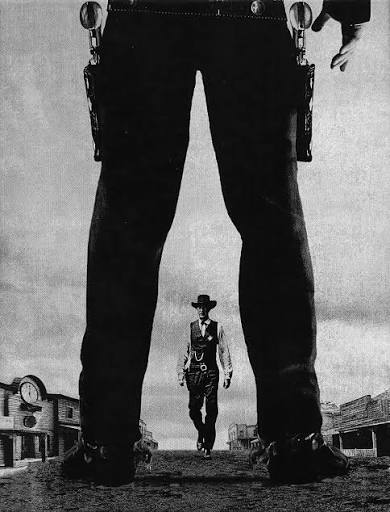
FANS OF WESTERN MOVIES know the trope well: the showdown. Some villain has been terrorizing the townsfolk. The sheriff or some other hero—perhaps even a mysterious stranger!—has tried peaceful means to end the conflict to no avail, and at some point, the hero is forced into a climactic duel of good versus evil.
The people scatter as the righteous sheriff and the evil gunman step out into the street. A gust of wind stirs up the dust; in the background, tumbleweeds blow past. Hands poised and motionless above their holsters, the two men silently face each other for a few moments before quickly reaching for their guns. Shots ring out, and there’s a tense moment as moviegoers wait to see who will fall to the ground, even though they already know the answer. The villain is dead; the hero has saved the day. Peace is restored.
The gospel of Luke, obviously, is not a classic Western, nor should we think of the Pharisees as “bad guys” in the one-dimensional way that they’re often portrayed on screen. But the next confrontation between Jesus and his opponents described in chapter 6 has the feel of a showdown. Such conflict was already anticipated in the dark words that Simeon prophesied over the baby Jesus back in Luke 2, and we’ve already seen how even the people of his hometown of Nazareth tried to kill him when he implicitly accused them of misreading Scripture in Luke 4.
In chapter 4, Luke describes how much of Jesus’ ministry took the form of teaching in synagogues. It was in the synagogue in Capernaum that Jesus miraculously freed a man from demonic oppression. Surely there was at least one Pharisee present, but Luke doesn’t say, nor does he indicate that anyone raised a question about Jesus doing such a miracle on the Sabbath. It was generally understood that the work of healing could potentially be done on the Sabbath, but only if someone’s life was at stake. Would any Pharisees present have considered the exorcism to be this kind of exception? Probably not. But at this point, no one objects.
The Pharisees don’t stay silent for long. There’s a progression in the stories, with the conflict rising at each turn. Again, Luke tells us nothing about any objections being raised in the Capernaum synagogue. When the scribes and Pharisees make their debut in the narrative, however, they appear to be a delegation, presumably with the purpose of evaluating Jesus’ ministry. When he forgives the paralytic’s sins, they think Jesus is blaspheming but don’t say anything. Later, they openly question Jesus’ practice of sharing table fellowship with tax collectors and sinners, and still later accuse his disciples of desecrating the Sabbath by picking grain.
Meanwhile, Jesus’ responses to their questions and criticisms seem increasingly confrontive as well. He answers the questions about table fellowship and fasting directly, as if the questions were honest ones. But when the Pharisees accuse the disciples of violating the Sabbath, Jesus begins his response with “Have you never read what David did…?”—a way of saying that they’ve read it but haven’t understood it. That’s the prelude to his throwing down the rhetorical gauntlet: “The Son of Man is Lord of the Sabbath” (Luke 6:3-5, NIV).
The Pharisees, of course, refused to accept this, as the next confrontation shows. Here’s the setup:
On another Sabbath he went into the synagogue and was teaching, and a man was there whose right hand was shriveled. The Pharisees and the teachers of the law were looking for a reason to accuse Jesus, so they watched him closely to see if he would heal on the Sabbath. But Jesus knew what they were thinking and said to the man with the shriveled hand, “Get up and stand in front of everyone.” So he got up and stood there. (Luke 6:6-8)
If the Pharisees had believed Jesus when he claimed to be Lord of the Sabbath, they wouldn’t now be trying to catch him in the act of what they would consider to be Sabbath-breaking. Moreover, in Luke’s previous vignette in the grainfield, the Pharisees seemed to appear out of nowhere, pointing fingers. Where did they come from? Luke doesn’t tell us whether it was just a coincidence or they had been spying on Jesus. But whatever the case was then, it’s clear now that they’re actively spying on Jesus. They didn’t come to hear the sermon. They came looking for a reason to accuse Jesus of being a lawbreaker.
The setting, once again, is the synagogue, perhaps in Capernaum. That Sabbath morning, a man with a useless hand is present. In the New International Version, Luke describes the hand as “shriveled”; the word is used to describe things that are literally or metaphorically dry and withered. The hand may have been paralyzed and the muscles atrophied.
Matthew, Mark, and Luke each have their own version of the story. There’s no indication in any of them that the man has come to the synagogue to be healed or to ask Jesus for healing. Luke’s version differs only slightly from Mark’s, but the differences may be significant. It’s only in Luke, for example, that we read that Jesus had already begun teaching; one gets the impression that he interrupted the sermon to heal the man’s hand.
If so, why? Mark says nothing, but Matthew’s version says that the Pharisees asked Jesus directly, “Is it lawful to heal on the Sabbath?” (Matt 12:10). By contrast, in Luke, Jesus seems to initiate the healing not because the Pharisees openly asked a question, but because “he knew what they were thinking.” As in the incident with the paralytic, the scribes and Pharisees were keeping their nasty thoughts to themselves, but Jesus knew them anyway.
Thus the showdown. I imagine Jesus preaching, then becoming aware of what his opponents are thinking: Will he do something unlawful? Will he heal someone on the Sabbath? Let’s hope so, so we can catch him in the act!
Jesus stops preaching. But he doesn’t start by confronting the scribes and Pharisees; he first stages the showdown for maximum effect. He tells the man with the shriveled hand to get up and stand in front of everyone. Silently, the man obeys. If there had been a spotlight, it would suddenly have been shining in the man’s eyes.
Surely everyone was waiting to see what would happen next, particularly the scribes and Pharisees. All eyes were on Jesus and the man who needed healing. What would Jesus do? Let’s find out.

