

AT THIS POINT in Luke’s gospel, we know nothing about Jesus’ ministry except that he has been teaching in the synagogues of Galilee, building a positive reputation throughout the region. He’s said nothing yet about miracles or healings, just teaching—though as we’ll see in a moment, Jesus has been doing miraculous works that haven’t come into the story. It’s against this background that Luke then tells the story of Jesus teaching in his own hometown synagogue in Nazareth. Given what he’s said so far, you’d expect things to go well.
And thus far, the response to Jesus’ sermon has indeed been enthusiastic, despite the fact that he has implicitly claimed to be the Messiah, a claim that always brings with it the potential for division and controversy. As I suggested before, however, given the ministry of John the Baptist, plus Jesus’ own initial popularity, it may be that people had already begun to think of him this way, even though to them he was still merely the son of Joseph the carpenter.
You might think that a preacher would be happy to have a response like that and leave well enough alone. But as we’ll continue to see in Luke’s gospel, Jesus knows what the people are thinking. Perhaps he read their minds; perhaps he overheard some of the chatter in the congregation. Whatever the case, he knows that they haven’t yet understood—let alone accepted!—the scope and nature of his mission. So, he begins to challenge them:
Jesus said to them, “Surely you will quote this proverb to me: ‘Physician, heal yourself!’ And you will tell me, ‘Do here in your hometown what we have heard that you did in Capernaum.’” (Luke 4:23, NIV)
The proverb was already well-known; it generally meant that those who helped others should take care of their own houses or families as well, or even make them the priority. He quotes the saying as a way of encapsulating the desire that he knows is in their hearts: they had heard of miracles he had done in Capernaum (again, miracles which Luke doesn’t mention) and wanted him to do the same for them. I imagine the people of Nazareth thinking something like, We get it; Capernaum is your new home. But Nazareth is your hometown. You grew up here, so this is where your allegiance should be, right? Surely you’re going to take care of your own people? In their minds, they are presuming upon his loyalty and hoping to get something for themselves.
In response, Jesus leaves aside the question of whether he will do any miracles in Nazareth. Instead, he goes to the heart of what’s wrong with their attitude:
“Truly I tell you,” he continued, “no prophet is accepted in his hometown. I assure you that there were many widows in Israel in Elijah’s time, when the sky was shut for three and a half years and there was a severe famine throughout the land. Yet Elijah was not sent to any of them, but to a widow in Zarephath in the region of Sidon. And there were many in Israel with leprosy in the time of Elisha the prophet, yet not one of them was cleansed—only Naaman the Syrian.” (vss. 24-27)
What the New International Version translates as “truly” in “Truly I tell you” is the Hebrew word amen, which when used this way signals that what’s about to be said is truly important. But what he says is neither what the congregation expected nor what they wanted to hear. “No prophet is accepted in his hometown,” he declares, as if to say, Remember how the prophets of old did things God’s way? It brought them rejection, even from God’s people, even from the people of their own hometown. The people of Nazareth, in other words, his old neighbors, wanted him to be loyal to them, but he knew they weren’t loyal to God’s plan.
To press his point, he cites two stories from the lives of the prophets Elijah and Elisha. The story of Elijah and the widow of Zarephath can be found in 1 Kings 17:7-24. God had chosen the poor widow to keep Elijah fed during a severe and life-threatening drought and famine. Through Elijah, God miraculously provided an endless supply of flour and oil, so she could continue to make bread for Elijah and her family. Later, when her son died from an illness, Elijah brought him back to life. The widow said to Elijah, “Now I know that you are a man of God and that the word of the LORD from your mouth is the truth” (vs. 24).
The story of Naaman the Syrian can be found in 2 Kings 5:1-19. Naaman was a great warrior who suffered from leprosy. A Jewish servant girl told him that there was a great prophet who could cure him. When Elisha sent a message telling him to wash himself seven times in the Jordan, Naaman scoffed at what seemed like such trivial advice. But his servants urged him to do it anyway, and of course, he was healed of his leprosy. When he finally met Elisha face to face, Naaman said, “Now I know that there is no God in all the world except in Israel” (vs. 15).
“Now I know.” The miracles were a witness that brought these two people to faith in the one true God. One was a lowly widow; the other would have been considered unclean because of his disease.
And both were Gentiles.
Jesus was reminding them that even in the stories of the prophets of old, God showed healing grace toward Gentiles. Surely the people in the synagogue believed in and revered the stories. But would they accept the implication that Gentiles could be part of God’s purposes, or that the Messiah’s mission could be for their benefit too? Luke describes the people’s reaction:
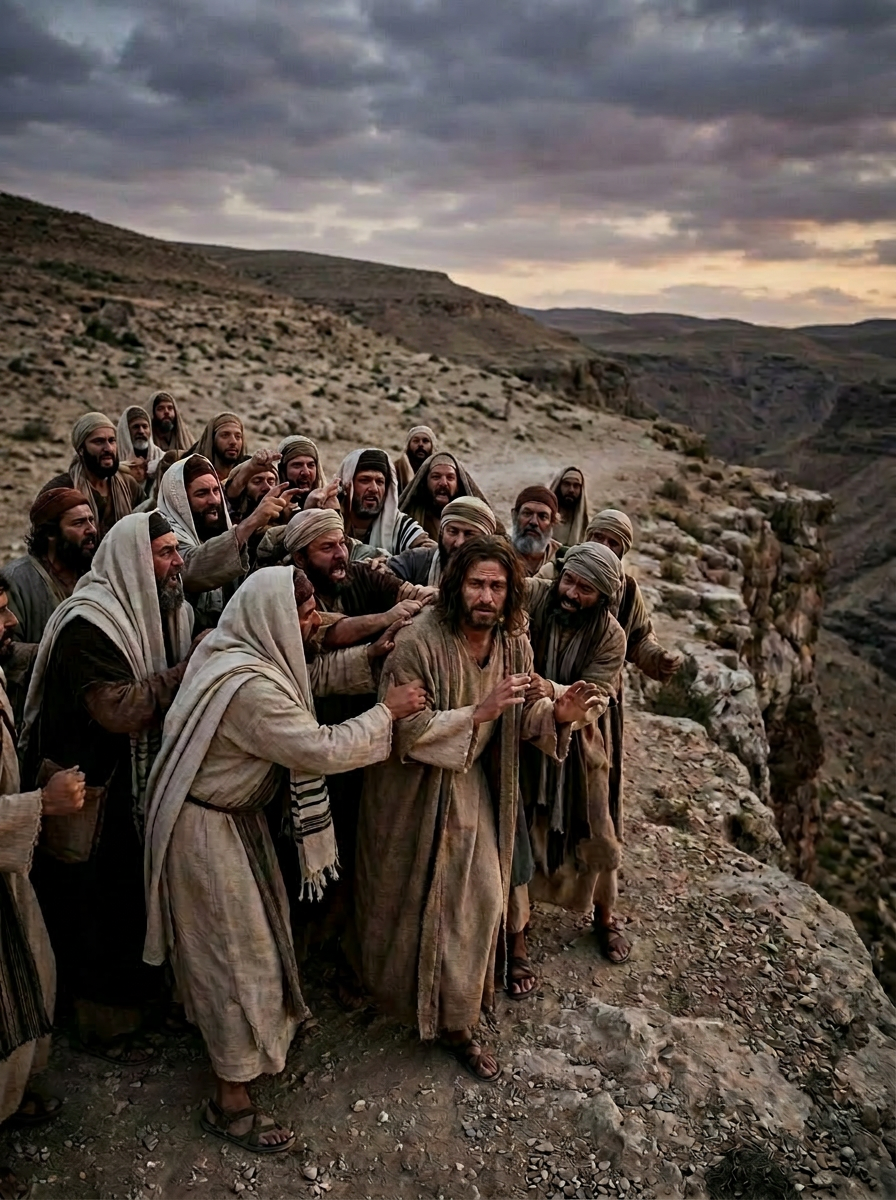
All the people in the synagogue were furious when they heard this. They got up, drove him out of the town, and took him to the brow of the hill on which the town was built, in order to throw him off the cliff. But he walked right through the crowd and went on his way. (vss. 28-30)
Luke doesn’t say how Jesus “walked right through” such an angry mob. Was Mary there, begging everyone to stop? But we’re probably meant to think of this as a miraculous escape. If so, it’s deeply ironic that this is the only miracle the people got, and doubly so given the story that follows, in which Jesus does a miracle in the synagogue of Capernaum.
Jesus passed the test in the wilderness because he demonstrated he was ready to do things God’s way, even at great cost to himself. That was not, unfortunately, the mindset of the people of Nazareth.
Is it ours?
 Squinting through Fog ("The Fog Blog")