
RECENTLY, we saw how the people who had been coming out to the wilderness to hear John the Baptist’s fiery preaching began wondering among themselves whether he could be the Messiah. Indeed, in the gospel of John, the Jewish leaders specifically asked him if he was the Messiah, or Elijah, or the Prophet that Moses himself predicted would one day arise from among God’s people (see Deut 18:15). The Baptist denied being any of these, claiming only to be the one making a straight path for the one who would come after him (John 1:26-27; Luke 3:16).
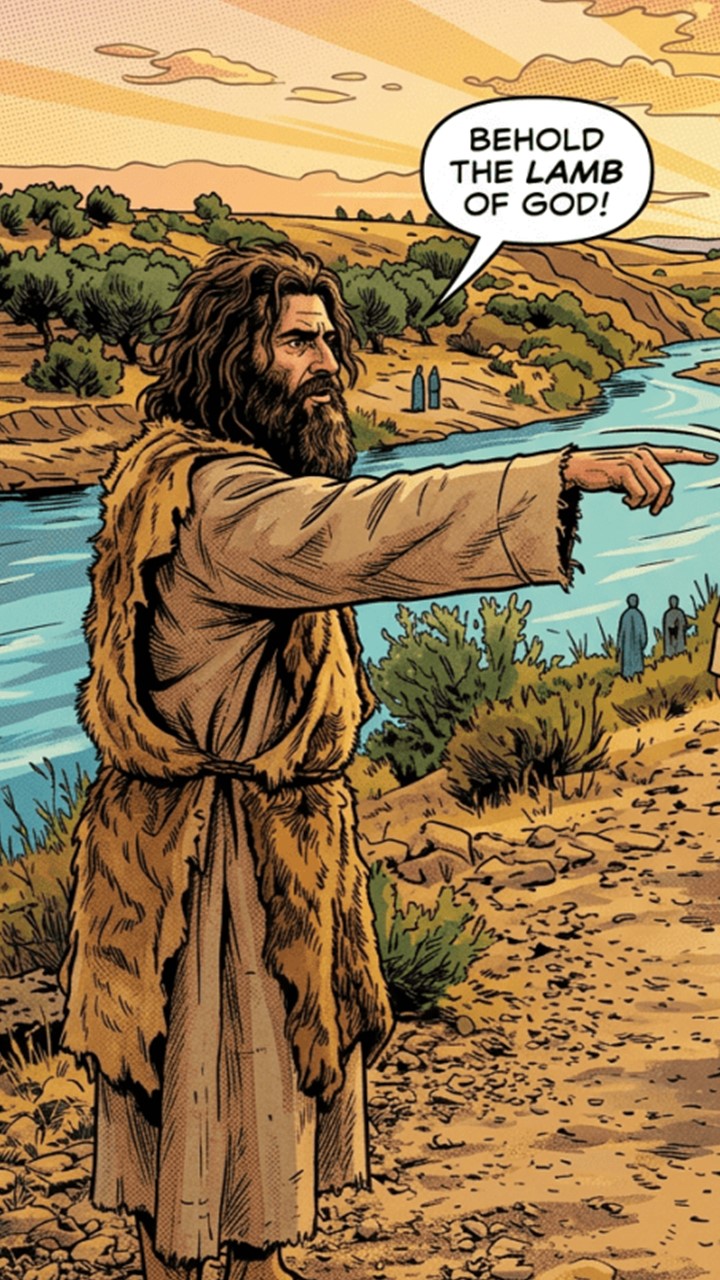
The people, in other words, already had an active expectation that the Messiah would come, perhaps soon, and John stoked those flames. Moreover, as can be seen in the Fourth Gospel, he actually told them that the Messiah was already among them, and the next day specifically declared Jesus to be God’s chosen and the Lamb of God (John 1:26-34).
It seems safe to say, therefore, that given such general hopes and John’s influence, some idea that Jesus might be the Messiah was already in the air even as his public ministry began, and that the ministry itself would help to either confirm or disconfirm that hope.
Luke has already told us that Jesus’ Galilean ministry opened to rave reviews. Would that continue? Would people believe he was the Messiah?
These are questions to keep in mind as we read Luke’s first full description of a public act of Jesus’ teaching ministry in Galilee. The scene takes place in the synagogue of his hometown of Nazareth:
He went to Nazareth, where he had been brought up, and on the Sabbath day he went into the synagogue, as was his custom. He stood up to read, and the scroll of the prophet Isaiah was handed to him. Unrolling it, he found the place where it is written: “The Spirit of the Lord is on me, because he has anointed me to proclaim good news to the poor. He has sent me to proclaim freedom for the prisoners and recovery of sight for the blind,
to set the oppressed free, to proclaim the year of the Lord’s favor.” (Luke 4:16-19, NIV)
At this point, Jesus is probably already living in Capernaum, but pays a visit to his old stomping grounds, in part perhaps to visit his mother. Luke tells us that he habitually attended synagogue on the Sabbath. The synagogue ruler in his hometown already knew who he was, and may have chosen Jesus to read the morning’s selection from the Prophets because of his growing reputation as a teacher. It’s possible that the text Jesus read had already been chosen, but Luke seems to hint that Jesus chose it himself.
The passage is from Isaiah 61:1-2, a text that was already understood to have messianic implications. The quotation in Luke, however, isn’t exact; Luke’s version both adds and subtracts from the passage in Isaiah. What’s missing is a line about binding up the brokenhearted; such words can describe the sorrow of God’s people in exile (see, e.g., Ps 147:2).
What’s added is the line in Luke about bringing “recovery of sight for the blind.” Those words aren’t in Isaiah 61, but the idea of giving sight to the blind can be found earlier in the prophet’s words:
I will keep you and will make you
to be a covenant for the people
and a light for the Gentiles,
to open eyes that are blind,
to free captives from prison
and to release from the dungeon those who sit in darkness. (Isa 42:6b-7)
This is yet another messianic passage, describing the mission of God’s Spirit-filled Servant. I’m reminded here of Simeon’s prophecy about Jesus in the Jerusalem temple, that the baby would be “a light for revelation to the Gentiles” (Luke 2:32). Could that be one reason why Luke’s quotation of Isaiah is different—to draw subtle attention to the fact that the Messiah’s mission would embrace the Gentiles? Who knows? But as we’ll see shortly, that reading certainly fits with what will happen before the end of the chapter.
Luke describes what happened next:
Then he rolled up the scroll, gave it back to the attendant and sat down. The eyes of everyone in the synagogue were fastened on him. He began by saying to them, “Today this scripture is fulfilled in your hearing.” (Luke 4:20-21)
Jesus sat down when he finished reading from Isaiah. But that didn’t mean he was finished speaking. Rabbis customarily sat to teach; as with the Sermon on the Mount, for example, sitting down was a sign that the lesson was about to begin (Matt 5:1-2). All eyes were on Jesus. Luke’s language tells us that the people weren’t just looking at him; they were staring at him intently, waiting to hear what he would say.
And what he said pleased them. Luke says that Jesus “began” with the claim that Isaiah’s prophecy was already being fulfilled. We don’t have the rest of the sermon, but to Luke, it was the first line that counted, and it seems unlikely to me that anyone would have missed that Jesus was claiming to be the Messiah.
Was that too much, too soon? Apparently not:
All spoke well of him and were amazed at the gracious words that came from his lips. “Isn’t this Joseph’s son?” they asked. (vs. 22)
There are different ways to understand the question they were asking themselves. Luke has already told us, at the beginning of the genealogy in chapter 3, that Jesus “was the son, so it was thought, of Joseph…” (3:23). The people’s understanding of who Jesus was, in other words, was limited. The people are amazed by Jesus because they’re used to thinking of him only as the carpenter’s son, the kid who used to run around their neighborhood. And there may be the suggestion here of a sense of pride and privilege, as when small town newspapers would run stories about some local boy who made it big. The Messiah is from Nazareth? Surely that’s good for us!
Some interpreters, though, read the question negatively, as if the people were grumbling, “He’s just that snotty little kid from down the street. Who does he think he is?” I respectfully disagree; I think it makes more sense in context to read their question as part of their amazement.
Still, as we’ll see next, it will only be a matter of moments before that amazement flips to murderous rage.

