

I DON’T KNOW if it still happens. But a generation ago, kids growing up in church were taught a well-known little ditty: “This little light of mine, I’m gonna let it shine.” Can you hear it in your head? Sometimes, a whole group of youngsters would be paraded before the church to sing the song together, complete with cute little hand gestures. I always enjoyed watching performances like this, scanning to see which kids were singing with gusto and which ones looked like they would rather be somewhere else, anywhere else. At that age, I would definitely have been in the latter category.
But did even the enthusiastic kids understand what they were singing? Because the idea of letting your light shine as a Christian is about as good a one-line summary of discipleship as you can get.

THE MAIN BODY of the Sermon is about to begin. But first, Jesus needs to wrap up the introduction, in which he describes in general terms the life of those who truly embody God’s kingdom. He’s already spoken poetically in the Beatitudes of a blessed life of righteousness. True disciples are in turn a much-needed blessing to others; they are what Jesus called “the salt of the earth.”
And similarly, with a new but familiar metaphor, Jesus now suggests that their lives are like a beacon of light in a dark world:
You are the light of the world. A town built on a hill cannot be hidden. Neither do people light a lamp and put it under a bowl. Instead they put it on its stand, and it gives light to everyone in the house. In the same way, let your light shine before others, that they may see your good deeds and glorify your Father in heaven. (Matt 5:14-16, NIV)
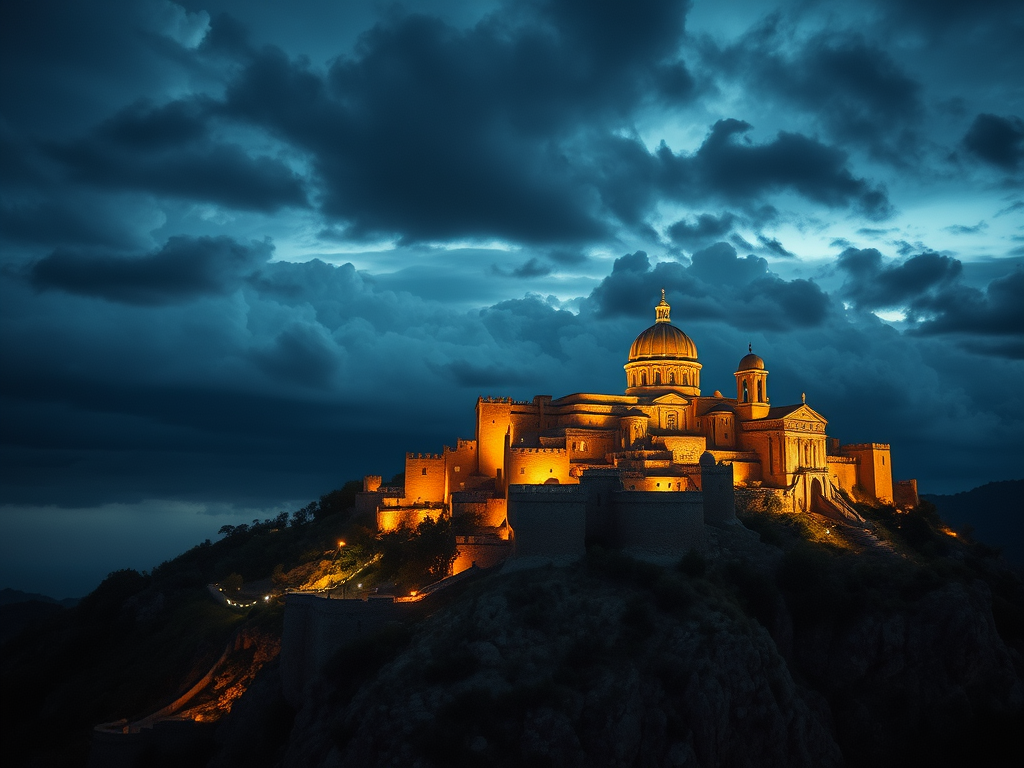
Again, Jesus uses imagery that would have been immediately familiar to everyone listening, but with layers of added meaning. On one level, for example, a city built at the top of a hill obviously can’t be hidden; it can be seen from miles and miles around, especially if we imagine the warm glow of oil lamps shining through windows at night.
But on another level, many of Jesus’ hearers would surely have thought of Jerusalem, sitting majestically atop Mount Zion. They knew their history. Jerusalem, the city of David. Jerusalem, destroyed by the Babylonians, its people dragged away into exile. Jerusalem, the city rebuilt by the remnant that returned. And now, Jerusalem, living under the oppressive shadow of the Roman Empire.
The people still held out the hope that one day the city would be restored to its rightful place as the prophets had promised. Centuries before, for example, in the time before the exile, Micah had issued an oracle about the so-called “last days.” In those coming days, he prophesied:
the mountain of the LORD’s temple will be established
as the highest of the mountains;
it will be exalted above the hills,
and peoples will stream to it. (Mic 4:1)
In Micah’s vision, the nations aren’t streaming to Jerusalem to destroy it; they are coming to the temple to learn the ways of God, ushering in a time of peace. Unfortunately, it’s not clear that the people of Jesus’ day wanted that kind of peace; they just wanted their land back and the Romans out. That, I think, is the truncated hope Jesus ignited on Palm Sunday — before he was crucified, in part, for not being the Messiah people expected.

IF IT’S OBVIOUS that a city on a hill can’t be hidden, it’s equally obvious that no one would light a lamp and then cover it with a bowl. That would defeat the purpose. Rather, the lamp would be raised up to cast as much light as possible in the house.
Jesus doesn’t leave the application of the metaphor vague. Those who would be his disciples are the lamp. It’s their calling to shine brightly, visibly. As I’ve suggested before, Jesus is not describing a private spirituality but a public one; his followers are to enact the righteousness of the kingdom in ways that others can see.
But wait: doesn’t Jesus say just the opposite later in the Sermon? At the beginning of Matthew 6, we read this:
Be careful not to practice your righteousness in front of others to be seen by them. If you do, you will have no reward from your Father in heaven. (Matt 6:1)
That may sound like a contradiction. But it’s clear from the context that Jesus is talking about something else. In Matthew 5, he’s describing the kind of righteous life that stems from humility, compassion, and the desire to see God’s will done in the world. Others will see what these people do, but it’s not done for their approval. Indeed, as Jesus has already said, sometimes the result will be persecution instead.
In Matthew 6, however, Jesus is describing a showy kind of piety whose purpose is to elicit the admiration of others. Ooh, look how much money he gave to the church building fund. I wish someone would announce my name from the pulpit. The good deeds of Matthew 5 are ultimately done for the glory of God; the pious deeds of Matthew 6 are done for the glory of the people doing them. If what they want is applause, Jesus suggests, then fine, that’s what they’ll get. But they shouldn’t expect any reward from God.
THE WORDS OF Jesus assume an uncomfortable truth: the world is a dark place in need of light. That, in fact, is one of the primary metaphors of the gospel of John. And it’s only in John’s gospel that we read this pronouncement of Jesus, one that would trigger pushback from those who heard him:
I am the light of the world. Whoever follows me will never walk in darkness, but will have the light of life. (John 8:12, NIV)
If I were stuck in a dark place, I would be grateful for light. Wouldn’t you? That presumes, of course, that we know we’re walking in darkness.
It was the Pharisees who challenged Jesus for saying he was the light of the world, and interestingly, they challenged him on a technicality and not on the content of his claim. Reading between the lines, I suspect the Pharisees didn’t want to pursue the idea that they had to follow Jesus to have the light, to not walk in darkness themselves. So instead of debating him on that point, they did the next best thing: they tried to argue that they didn’t need to listen to him, because his testimony about himself was out of bounds.
But here’s the astonishing thing for those who do accept Jesus’ words. In John, Jesus says that he is the light of the world. In Matthew, he says that we are the light of the world.
Just ponder that for a moment.
We are called, in other words, to walk in his footsteps, to live in a way that others can see the character of Jesus in us. Some, when they see this, will push back because they don’t want to acknowledge the darkness. But for others, being able to see living, breathing examples of the righteousness and shalom of God’s kingdom will be a beacon of hope.
You may think you’re nothing special. And in some ways, you’re right; there’s nothing about us in ourselves that qualifies us to be light in the darkness. That is only our calling because God in Christ has made it so.
So, take that calling seriously. How would you live, if you knew that others needed to see Jesus in you?
 Squinting through Fog ("The Fog Blog")