

I DON’T KNOW about you, but I personally have never fasted for a full forty days. Not even close; I think the longest was something like a day and a half, and even then I allowed myself water and non-caloric beverages like tea and black coffee. And while so-called intermittent fasting is widely touted these days for health reasons, it typically doesn’t involve going even one day without any calories at all. So how about forty times that? And voluntarily? Frankly, it’s hard for me to imagine.
But Jesus, apparently, did just that.

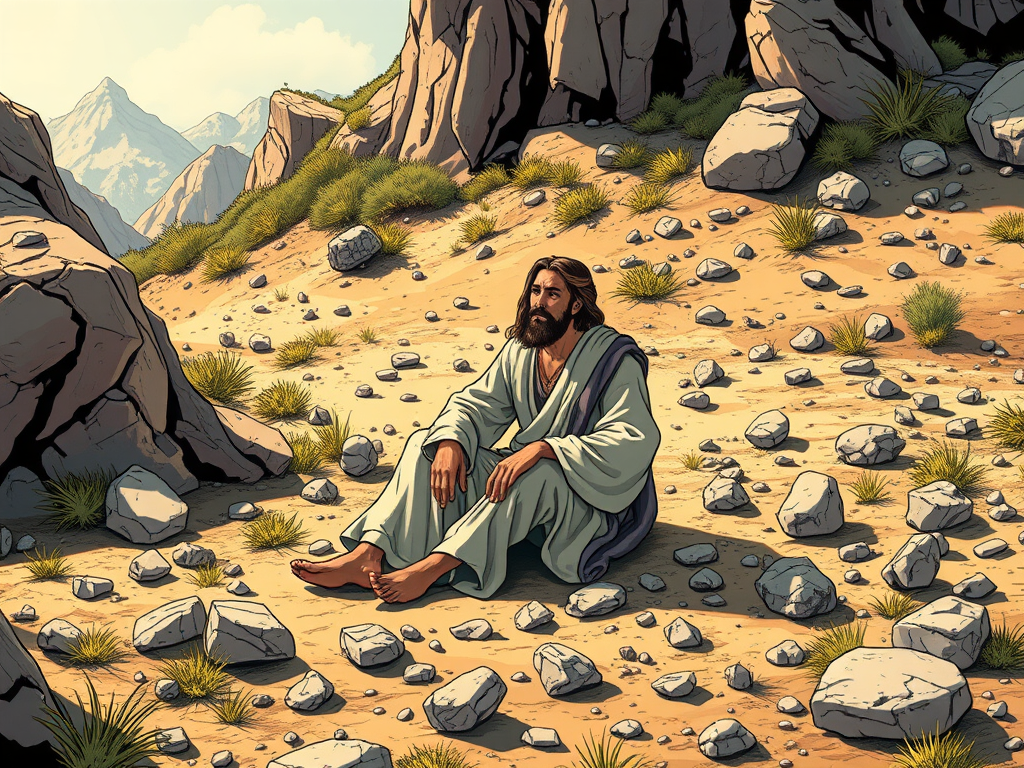
JESUS HAD JUST been baptized publicly by John the Baptist. John saw the Spirit of God come down like a dove, alighting on Jesus. As it did, a voice from heaven declared, “This is my Son, whom I love; with him I am well pleased” (Matt 3:17, NIV).
That’s a pretty auspicious beginning for a ministry, wouldn’t you say? But immediately after this, that same Spirit put Jesus to the test:
Then Jesus was led by the Spirit into the wilderness to be tempted by the devil. After fasting forty days and forty nights, he was hungry. The tempter came to him and said, “If you are the Son of God, tell these stones to become bread.” (Matt 4:1-3, NIV)
“He was hungry,” Matthew says rather matter-of-factly. But this hunger became an opportunity for Satan to tempt Jesus. How? What made it such a devilish strategy?
Remember, the Spirit led Jesus into the wilderness to be tempted, not to fast. Fasting was Jesus’ choice, presumably as a way of disciplining himself to obey God and resist Satan. He could have chosen to break his fast. Hunger is, after all, a legitimate human need, and forty days of fasting seems like pretty severe discipline. Surely that was enough?
But in a sense, the question wasn’t whether he should break his fast, but how and why. The devil’s words — “If you are the Son of God” — don’t come out of nowhere. It was only three verses ago in Matthew’s gospel that a voice from heaven declared Jesus to be God’s beloved son, and the devil is calling this into question. Prove it, he seems to say. Look around you; don’t these stones remind you of bread? Aren’t you hungry? Then make them into bread. Come on, you’re the Son of God. You can do it. You know you want to.
The temptation, in other words, was for Jesus to let his hunger convince him to use divine power for his own benefit. His response is instructive:
It is written: “Man shall not live on bread alone, but on every word that comes from the mouth of God” (Matt 4:4).
Jesus is quoting the speech Moses gave to the people of Israel after his own disobedience cost him the privilege of entering the Promised Land with them. Poignantly, Moses had already reminded them of that sad fact as he retold the story of God’s faithfulness in the wilderness. It’s a sadder but wiser Moses who therefore reiterates the importance of humble obedience:
He humbled you, causing you to hunger and then feeding you with manna, which neither you nor your ancestors had known, to teach you that man does not live on bread alone but on every word that comes from the mouth of the LORD. (Deut 8:3).
Neither Moses nor Jesus is saying that bread doesn’t matter. But they are saying that obedience to God matters more. And considering what happened in John 6 when Jesus called himself the bread of life, that’s a lesson more people needed to hear.
IN TEACHING HIS followers to pray, Jesus isn’t saying, “I know you have a lot of things you want from God, so here are the words you have to use.” He wants them to pray with the proper perspective, with the eschatological big picture of who God is and what he’s doing. The first part of the prayer, then, sets the tone: it looks forward to a day in which the entire world would bow to the sovereign rule of God.
Should we suppose, then, that the second part of the prayer leaves that big-picture perspective behind? I doubt it. True, the prayer “Give us today our daily bread” (Matt 6:11) sounds like a turn toward the most fundamental of personal needs. But remember, this is the Jesus who told the devil that we don’t live by bread alone.
Moreover, even the prayer itself is less straightforward than it might sound. Part of the challenge is that the word typically translated here as “daily,” a perfectly ordinary word in English, is a puzzling one in the Greek. It’s used only twice in the New Testament: here and in Luke 11:3, the other version of the Lord’s Prayer.
But no one has found the word anywhere else outside the Bible, leading some scholars to suppose that Matthew and Luke made it up. Because there are no other uses of the word to use as a frame of reference, translators have proposed a number of quite different options. The one thing they tend to agree on is that the word probably doesn’t mean “daily” in any simple sense.
The majority opinion is that the word refers to something future, something yet to come. Taken that way, this petition echoes the previous ones. We know, for example, that God’s kingdom is already present in the lives of those who embody true righteousness. Yet we pray nevertheless that his kingdom would come in all its fullness, that the will of the King would be done throughout the earth.
How, then, would the prayer for bread be a big-picture, eschatological prayer? We pray for what we need today, but with an eye toward a future in which all needs will be forever met. We pray for the bread we need in order to live right now, but in gratitude for the One who declared himself to be the Bread of Life, the one whose sacrifice brings eternal life.
We may not live on bread alone, but that doesn’t mean we can live without it, either. Jesus knows this. The Father knows this. It’s with grace and compassion that Jesus invites us to pray for what we need.
When we do so, however, let’s remember that we’re not praying to get God to notice us or to give us what we want. We’re praying to align our hearts and imaginations with the one who already knows what we need before we ask. When that happens, we can receive bread both as a gift of grace today, and a taste of where God’s grace will be taking us in the future.
 Squinting through Fog ("The Fog Blog")