

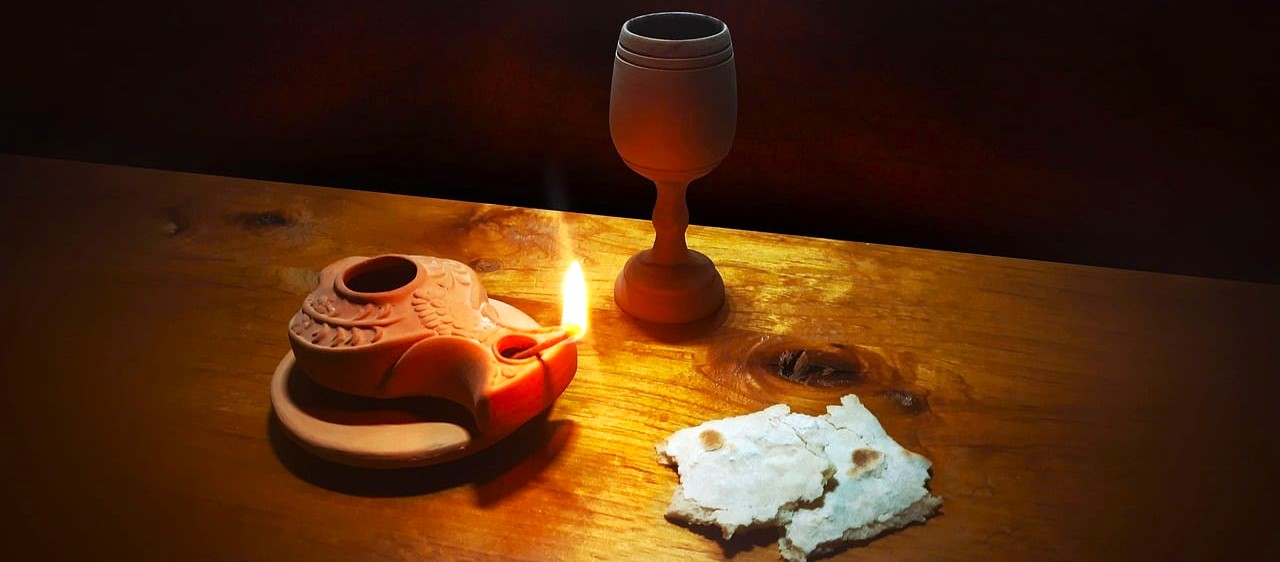
WHEN I WROTE out my previous reflections about fellowship, it was a Saturday. The following morning was Communion Sunday at our church. It made me think back to all the different ways our congregation has celebrated the Lord’s Supper over the years. So think for a moment: what’s been your experience?
Back in the day, the congregation stayed seated while ushers came down the aisles with trays bearing bits of bread and little plastic cups of grape juice. That’s what I was used to in the churches I had known. The person seated on the aisle would take a piece of bread or a cup, then pass the tray down the row to the next person. Eventually, when everyone in the sanctuary had a piece of bread, we would prayerfully eat it at the same time. Moments later, the same routine was followed for the juice.
Early on, it never occurred to me how much time went into preparing the elements. Someone, for example, had to set hundreds of cups in trays and fill them carefully by hand. A team of ushers had to be recruited, with backups for those who didn’t show up on a given Sunday. At some point, though, we eliminated the need for ushers by setting the trays out on tables placed around the perimeter of the sanctuary. People were asked to get their own bread and cup from the closest table, and to prayerfully take the elements when they were ready.
Then came the next time-saving innovation: prefab communion cups with a sip of juice already sealed into one end and a wafer sealed in the other. Worshipers would each be given a cup as they entered the sanctuary, and break them out at the proper time. In retrospect, it had to happen sometime: communion-to-go. Highly efficient, if lacking in aesthetics.
Your church has its own way of doing things, and you may feel strongly about what should or shouldn’t be done. Personally, I always objected to the “take the elements when you’re ready” idea, as if partaking of the Lord’s Supper was meant to be a purely private affair, only a matter between the individual and God. Think, for example, of how the apostle Paul scolded believers in 1 Corinthians 11; their way of remembering and celebrating the broken body of Christ was dishonoring and breaking the unity of the church body. Worship, to Paul, had an intrinsically social dimension, and the relationship between believers mattered.
Or think of Jesus, sitting down to his final Passover meal with his disciples, a meal to which he had been looking forward with great anticipation. It was already a commemorative meal, recalling the legendary exodus of God’s people from Egypt — like re-enacting an origin story to cement their identity as a people. Jesus looked around the table at the men who had been at his side for years, then changed the ancient narrative: there would be a new Passover, a new exodus, in his body and blood. In the future, whenever they sat down for a Passover meal, they were to actively bring back the memory of what he had done: “Do this in remembrance of me.”
I don’t how Jesus would have felt about our little plastic cups. Amused, perhaps? But I suspect he would have found the idea of the Lord’s Supper as an act of private devotion a bit odd.

GIVEN WHAT WE’VE seen in 1 John, I want to take this reflection a step further. Remember what the apostle wrote in verse 3 of the opening chapter. Here it is again, this time from the Common English Bible:
What we have seen and heard, we also announce it to you so that you can have fellowship with us. Our fellowship is with the Father and with his Son, Jesus Christ. (1 John 1:3, CEB)
The original apostles walked with the earthly Jesus. They knew the sound of his voice, and I imagine they knew the feel of his embrace. They broke bread together. And in their final supper as a group, they felt the touch of his hands as he washed their feet — much to their surprise and chagrin.
Shortly thereafter came the command given over the meal itself: Do this in remembrance of me.
John, the disciple whom Jesus loved, was reclining next to Jesus. What would he remember?
I suspect that for him, remembrance was not the mere recall of the facts of Jesus’ crucifixion and resurrection, as in, Oh, yes, that’s right. You died for my sake then rose again. Thank you very much. Rather, I imagine him entering once again into the fellowship of that moment around the table, the fellowship of the disciples with each other and with Jesus; the pain of having that fellowship sundered by betrayal and death; the joy of fellowship restored when they could once again see, hear, and touch their friend and master. John proclaims to his readers the truth about Jesus, the truth they already know and supposedly have believed. He does this to safeguard the fellowship between believers.
But there’s more. Although the word “fellowship” doesn’t appear in John’s gospel, its use here in 1 John reminds me of one of the dominant themes of his gospel: the intimacy between the Father and his only begotten Son. So when he writes in his letter, “Our fellowship is with the Father and with his Son, Jesus Christ,” he doesn’t mean that there’s one relationship with the Father and another with the Son. It’s one fellowship altogether, one communion: Father, Son, and all God’s children.
So the next time you take communion, think of the others around you, use a little imagination, and be astonished and grateful: you are being invited to enter into the loving fellowship of Father and Son.
 Squinting through Fog ("The Fog Blog")