
UNLESS YOU LIVE on a desert island or in a cave (in which case, I’m wondering how you’re able to read this?), there are lots of other people in your life. Some of them you care deeply about, like your family and closest friends, even if they sometimes make you crazy. Some are acquaintances: you know them, but not well. You may know their faces or names, but little if anything else about them.
And there may be hundreds of people on the periphery who come and go, whose lives brush against yours briefly and often invisibly. Our lives together on this crowded planet are interconnected, but we simply aren’t capable of being equally aware of every life that inadvertently touches ours, let alone every life we ourselves may inadvertently touch. All of this is to be expected.
But while some people’s lives are naturally tangential to ours, some remain on the periphery because we put them there, whether we consciously intend to or not. They’re the minor characters, the bit players, the replaceable extras in the unfolding play in which we take center stage. We treat them as less important, less valuable to the story, not taking the time to imagine that they might have stories of their own. They exist only on the margins of our lives, and sometimes, pushed there by enough people, on the margins of society.
They would be the shepherds in the drama of the one born to be King of the Jews — except that God chose to write the story differently.

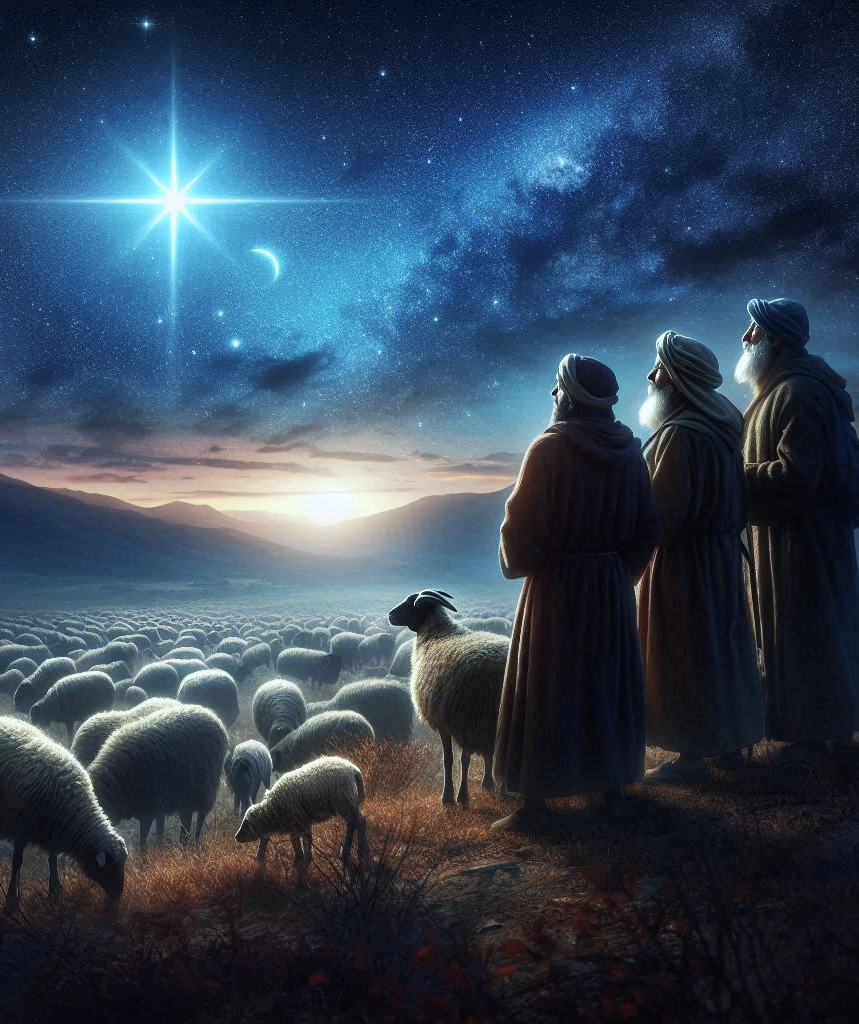
SHEEP AND SHEPHERDS were a normal and valuable part of the nomadic life of the early Israelites. During the time of David and after, a good king was considered a shepherd of his people. Even God himself was likened to a shepherd who cares for his flock, both in the Psalms and in the parables of Jesus. That’s what made it meaningful for Jesus to declare to his followers that he himself was the Good Shepherd.
But that doesn’t mean shepherds had much social standing in the time of Jesus. They served a necessary function, but were looked down upon as menials, people whose station was not much higher than that of the animals they tended.
And yet…
When the most momentous event in human history occurred, when God came to humanity through a baby in a manger, the first public announcement was to…shepherds. God didn’t hire a publicist or consult with the marketing department. He didn’t identify the top social influencers and ingratiate himself into their networks. He didn’t start with emperors or kings, presidents or CEOs.
No: the greatest good news of all time was given first to a largely unseen, marginalized group. Overlooked and taken for granted by others who wanted their labor but not their stories, the shepherds were seen and blessed by God.
Today, it might be the public relations equivalent of giving a major press release first to a field of migrant farm workers. Who does that?
We’ve heard the answer already: only the God who comes humbly as a baby in a manger.
THE THIRD SUNDAY of Advent is the day in which we traditionally remember the shepherds. And how we remember them may depend on our own social standing.
In what ways are we marginalized, overlooked, invisible, unseen? Advent can be a time in which we read the Christmas story again and take comfort in the fact God sees, values, and remembers the unseen.
But we also have to ask the opposite question. In what ways have we marginalized, overlooked, or failed to see others? This is the harder of the two questions, not only because it requires a healthy dose of humility, but because we may have only the dimmest awareness, if any, of people we don’t choose to see.
If you like, begin by thinking of all the people you depend on for their services. The person who rings up your groceries or delivers your mail. The person who mows your lawn or fixes a leak under your sink. The person who cleans your teeth, or teaches your kids, or brings dinner to your table. The list goes on.
Whom do we see and not see? Who gets a genuine smile, a handshake, a hug, a warm greeting, a word of gratitude — and who doesn’t? I’m not asking you to make everyone your friend or invite them all for supper. But we shouldn’t treat people as if they were only important for what they’re paid to do. We should treat them as people who have their own stories to tell — stories that might be fascinating, heartbreaking, or inspiring, if anyone took the time to listen.
We should treat them not as the people of Jesus’ day would have treated shepherds, but as God treated shepherds, as people worthy of tidings of comfort and joy from the mouth of angels.
That just might be the best way for us to pass on a bit of joy ourselves.
 Squinting through Fog ("The Fog Blog")