
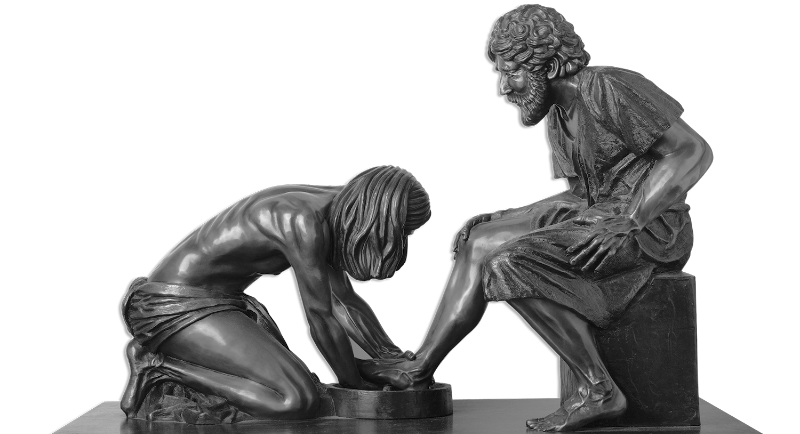
It was a simple yet profound moment, to me at least. The president of our seminary had been leading the faculty through month after month of difficult discussions about an ailing budget. A good deal of anxiety was in the air, and regularly scheduled faculty meetings didn’t give us enough time to work through all the implications of the various proposals for tightening our institutional belts.
Thus, a longer session was scheduled, which included lunch. That day, we lined up to load our disposable plates with food and sit around tables to chat.

The room soon filled with the lively buzz of lunchtime conversations. At some point, however, it was time to transition back to the meeting. The president rose from his table, picking up his plate and utensils to throw them away. But he also began gathering the detritus around him from other people’s meals: used plates, forks, napkins.
When he came to the table where I was sitting, I suddenly thought of Peter in the Upper Room, blurting out, “You shall never wash my feet!” I hastily got up from the table and followed the president’s example, collecting other people’s trash and throwing it away.
The president had been a pastor for many years — and often, this is what pastors do. They lead congregations by serving in whatever way is needed at the moment. In small congregations which don’t have the luxury of multiple paid staff positions, pastors find themselves doing many things that have nothing to do with preaching and evangelism. And hopefully, in doing so, they create an example for everyone else to follow.
. . .
On the church calendar, today is known as Maundy Thursday, the day on which we reflect back upon the scene from John 13, in which Jesus washes the feet of his astonished disciples. Jesus was their Lord and Master, the miracle worker who healed disease and cast out demons, who stilled the wind and the waves with nothing more than a verbal command. This man took the role of a menial servant, kneeling before each of them to wash the dust and sweat from their grimy feet. Then he told them:
You call me “Teacher” and “Lord,” and rightly so, for that is what I am. Now that I, your Lord and Teacher, have washed your feet, you also should wash one another’s feet. I have set you an example that you should do as I have done for you. (John 13:13-15, NIV)
Later, the apostle Paul would write these words to the believers in Philippi, urging them to have the same humble mindset as Jesus:
Who, being in very nature God,
did not consider equality with God something to be used to his own advantage;
rather, he made himself nothing
by taking the very nature of a servant,
being made in human likeness.
And being found in appearance as a man,
he humbled himself
by becoming obedient to death—
even death on a cross! (Phil 2:6-8)
Think about it for a moment. When Paul says that Jesus was “in very nature God” and then “made himself nothing” by taking on human form and “becoming obedient to death,” is he saying that in doing so Jesus was going against the nature of God or embodying it?
Paul was writing to Gentiles who were proud citizens of the Roman Empire, a social world that prized power and status. They were still learning what it meant to follow Jesus, and Paul was teaching them that God is a humble God, as demonstrated in the sacrificial life and death of Jesus.
A “humble” God? That hardly sounds like the way we would normally use the word “God.” It doesn’t mean that God is self-effacing or shy, or suffering from low self-esteem. It means that God is willing to lovingly subordinate his divine power and privilege to the needs of others.
Our world still prizes power and status. And we, like the Philippians, are still learning what it means to follow Jesus. So right here, right now, where might God be calling you to embody his example?
 Squinting through Fog ("The Fog Blog")