

IT’S ALMOST TIME for the yearly Passover feast, and Jerusalem is already thronged with pilgrims. Jesus and his disciples are making their way from Bethany into Jerusalem. The whole city of Jerusalem was already abuzz with the news of how Jesus had raised Lazarus of Bethany from the dead. And when the crowds along the road see Jesus riding on the back of a donkey, some of the people remember the ancient prophecy of Zechariah 9:9 that their Messiah, God’s anointed king, would come to them in this way.
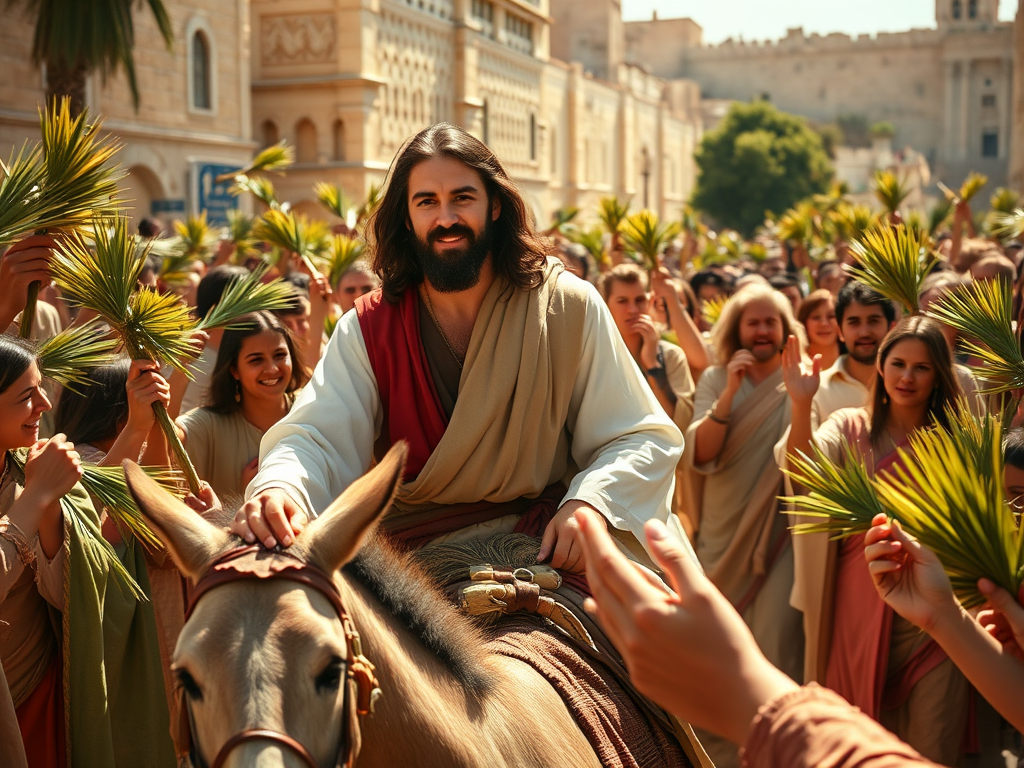
Excitedly, therefore, some spread their cloaks in the road before Jesus; others lay palm branches. “Hosanna!” they cry; “Lord, save us!” They acclaim Jesus as Messiah: “Blessed is he who comes in the name of the Lord.”
The religious leaders in Jerusalem are offended by this, and later, as Jesus teaches the crowds in the temple courts, they repeatedly challenge him. In response, Jesus tells a parable about a landowner who rented a vineyard out to tenant farmers who would work the vineyard and give the landowner a fair share of the harvest. But when the owner sent a servant to collect the fruit, the farmers killed him. The landowner sent another servant, and another, and finally his own son, thinking the tenants would have to respect his son’s authority. But the tenants killed them all, wanting to take the vineyard for their own.
Jesus tells that story to condemn the religious leaders for the way they have historically rejected God’s prophets, and now, God’s very own Son. But the leaders don’t seem to get the point yet. So Jesus asks them, “When the owner of the vineyard comes, what will he do to those tenants?” Correctly, they reply, “He will bring those wretches to a wretched end, and he will rent the vineyard to other tenants, who will give him his share of the crop at harvest time” (Matt 21:40-41, NIV).
Wisely, Jesus refrains from saying, That’s right, and I’m talking about you. Yes, you. Instead, he asks them if they’ve ever read the following passage of Scripture:
The stone the builders rejected
has become the cornerstone;
the Lord has done this,
and it is marvelous in our eyes.
Have they ever read it? Of course they have. It’s verses 22 and 23 from Psalm 118, the last psalm of the Hallel. Everyone in Jerusalem for the Passover, including the leaders themselves, would be expecting to recite that psalm as part of the ritual celebration. Indeed, even the cry of the crowds along the road, “Blessed is he who comes in the name of the Lord” is a quote from verse 26 of that psalm.
For the religious leaders debating with Jesus in the temple courts, it finally sank in: Jesus was talking about them. They began looking for a pretense to arrest him — ironically enacting the very rejection Jesus prophesied.
. . .
YEARS AGO, I built a wooden fence across the back of our property. It’s gone now, having been replaced by a new and professionally installed vinyl fence instead. But I remember the care I had to take to make sure the fence I built was straight and true, especially since the ground wasn’t level. One post out of alignment could throw the whole fence off.
Similarly, the cornerstone of a stone building had to be true or the whole foundation would be thrown off and the walls misaligned. Builders had to be careful to choose the right stone and set it carefully.
Jesus quotes the psalm in the context of the parable of the tenants, in which the servants and the landowner’s son were all murdered. But the point of quoting it isn’t necessarily about the violence of the rejection. Builders had to pick and choose; one stone might be rejected as inappropriate and another selected in its place. Rather, the point seems to be that for all their expertise, the builders didn’t choose in accordance with God’s blueprint. The stone they rejected became the foundation of what God had intended to build all along.
If the religious leaders understood that Jesus was talking about them, then his words were an opportunity to repent: Wait, what are you saying, Jesus? That we’re making the wrong choices, following the wrong plan? Well, we definitely want to do what God wants to do! Let’s talk. After all, you’d think they’d be obliged to listen to a man who raised someone from the dead. Unfortunately, they chose to double down on their resistance instead.
Later, when Peter and John were hauled before the Sanhedrin for miraculously healing a lame beggar and preaching the gospel, Peter remembered how Jesus had quoted Psalm 118 to his opponents and quoted it to the Sanhedrin in turn, insisting that Jesus himself was the cornerstone (Acts 4:11). Then, in the letter we know as 1 Peter, he would cite the psalmist again, this time adding parallel quotes from the prophet Isaiah, like this one:
See, I lay a stone in Zion,
a chosen and precious cornerstone,
and the one who trusts in him
will never be put to shame. (1 Pet 2:6; Isa 28:16)
And if Jesus is the cornerstone, then what? As Peter tells his Jewish readers, those who come to Jesus, whom he calls the “living stone,” become living stones themselves, to be built by God into a “spiritual house” (1 Pet 2:4-5). “Once you were not a people,” Peter tells them, “but now you are the people of God; once you had not received mercy, but now you have received mercy” (vs. 10).
Similarly, the apostle Paul, writing to Gentiles, says this:
Consequently, you are no longer foreigners and strangers, but fellow citizens with God’s people and also members of his household, built on the foundation of the apostles and prophets, with Christ Jesus himself as the chief cornerstone. In him the whole building is joined together and rises to become a holy temple in the Lord. And in him you too are being built together to become a dwelling in which God lives by his Spirit. (Eph 2:19-22)
We’ll spend some time unpacking Psalm 118 in itself. But I wanted you to see yet again how much the perspective of the New Testament, of Paul, of Peter, even of Jesus himself, is steeped in the worldview and language of the Psalms. What the psalmists wrote centuries before in their own contexts and for their own particular purposes is woven into a larger tapestry of meaning — and our own lives as believers are woven into the tapestry as well.
The Lord has done this, and it should be marvelous in our eyes.
 Squinting through Fog ("The Fog Blog")