

BOTH MY WIFE and I come from cultures that have traditionally valued sons over daughters, and mothers over women who are unable to have children. My own mother had been an only child for most of her life. She had had an older brother, but he died tragically of peritonitis at the age of eleven. When I was born, therefore, my grandmother wanted to adopt me so she and Grandpa would have a male heir. My parents, as you might guess, did not agree. But in my father’s extended family, a couple gave one of their babies to a childless cousin so she wouldn’t have to bear the shame of childlessness.
All of this may sound odd or even unthinkable to many Americans today. We live in a culture in which women’s rights have been championed and one’s value as a person is independent of whether or not you have children — more or less. Increasingly, childbearing itself is considered a personal choice as opposed to a perceived requirement of full adulthood.
But that’s not the way it was in biblical times. Think, for example, of the way the twelve tribes of Israel came about: through an escalating competition between the sisters Leah and Rachel for the love of their husband Jacob. Both women believed that the one who could give him more sons would become Jacob’s favorite wife.
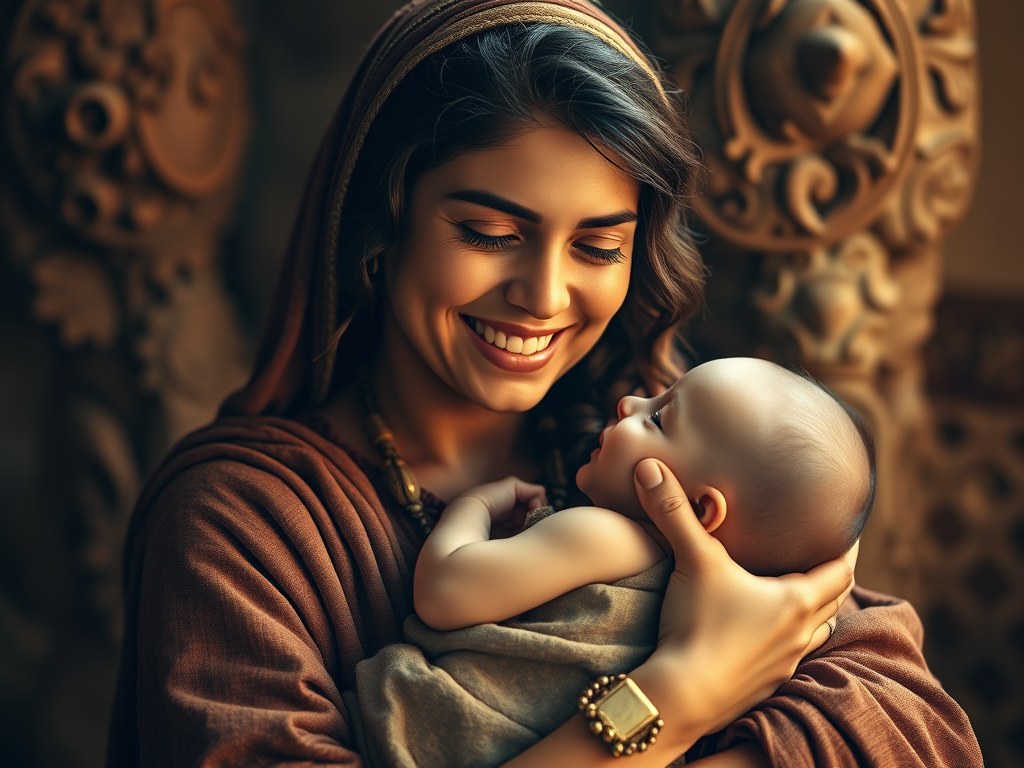
When Leah was able to have children and Rachel was not, Rachel cried out to Jacob, “Give me children, or I’ll die!” The compromise solution was for Jacob to have children through a woman named Bilhah, one of Rachel’s servants — and Bilhah did indeed end up bearing Jacob two sons. Tellingly, when the first was born, Rachel said, “God has vindicated me and given me a son.” At the birth of the second, Rachel said, “I have had a great struggle with my sister, and I have won” (Gen 30:1-8).
And you thought your family was complicated.
Or consider the story of Hannah, the mother of Samuel, the prophet who anointed both Saul and David as king. Hannah was one of two wives of a devout man named Elkanah; his other wife was named Peninnah. As translated in the New International Version, the drama of their story in 1 Samuel 1 is set up with a simple and direct sentence: “Peninnah had children, but Hannah had none” (vs. 2).
It’s important to note that Elkanah himself did not give Hannah any grief over this. He loved her and treated her with special care. But Peninnah was not so gracious. She needled Hannah about being childless year after year.
The Bible doesn’t tell us why. If I had to guess, drawing from the story of Leah and Rachel, Peninnah was jealous of the way Elkanah favored Hannah and used the only leverage she had to put Hannah in her place. The teasing was so intense that it drove Hannah to tears and even to the refusal to eat. “Hannah, why are you weeping?” Elkanah asked, trying to console her. “Why don’t you eat? Why are you downhearted? Don’t I mean more to you than ten sons?” (vs. 8). Not even that kind of compassion from her husband was enough to comfort Hannah.
Elkanah went every year to God’s house in Shiloh to offer sacrifices, and his wives went with him. One year, while there, Hannah offered an anguished prayer to God, vowing that if he would just give her a son, she would give him to God. Afterward, when she explained her prayer to Eli the priest, Eli gave her his blessing: “Go in peace, and may the God of Israel grant you what you have asked of him” (vs. 17).
And soon after, Hannah became pregnant with Samuel. She kept her vow, bringing Samuel to Shiloh as soon as the baby had been weaned from nursing. She gave Samuel over into Eli’s care and God’s service, and prayed a grateful, worshipful prayer that begins with these words:
My heart rejoices in the LORD;
in the LORD my horn is lifted high.
My mouth boasts over my enemies,
for I delight in your deliverance. (1 Sam 2:1)
Now think about it. If you had never heard those words before, and I asked you to guess where they might be found in the Bible, you might guess the Psalms. And in a way, you’d be close. That’s why I’m telling you Hannah’s story. Remember the words we read from the end of Psalm 113:
He raises the poor from the dust
and lifts the needy from the ash heap;
he seats them with princes,
with the princes of his people.
He settles the childless woman in her home
as a happy mother of children. (Ps 113:7-9)
The incomparably exalted God not only cares about human affairs, but specifically lifts up the lowly. In the psalmist’s time and culture, the people at the bottom of the social ladder included childless women. In Hannah’s case, God did indeed settle her as a happy mother, blessing her with five more children after Samuel, whom she visited every year in Shiloh.
But this isn’t just an illustration of the psalmist’s words. Rather, the psalmist is remembering the story of Hannah and using her words. Here is part of Hannah’s prayer:
He raises the poor from the dust
and lifts the needy from the ash heap;
he seats them with princes
and has them inherit a throne of honor. (1 Sam 2:8)
Sound familiar? The faithful devotion of Hannah, in other words, as embodied in her grateful prayer, passed into the worship life of God’s people through the Psalms. Her praise of God would be sung every Passover. Her words would be on the lips of Jesus and his disciples as they made their way to the Mount of Olives.
Could there be any greater honor? And all this for a woman who by the standards of her time was to be overlooked and forgotten.
The exalted God sees and cares about our lowliness. And he works in wondrous and unexpected ways.
 Squinting through Fog ("The Fog Blog")