

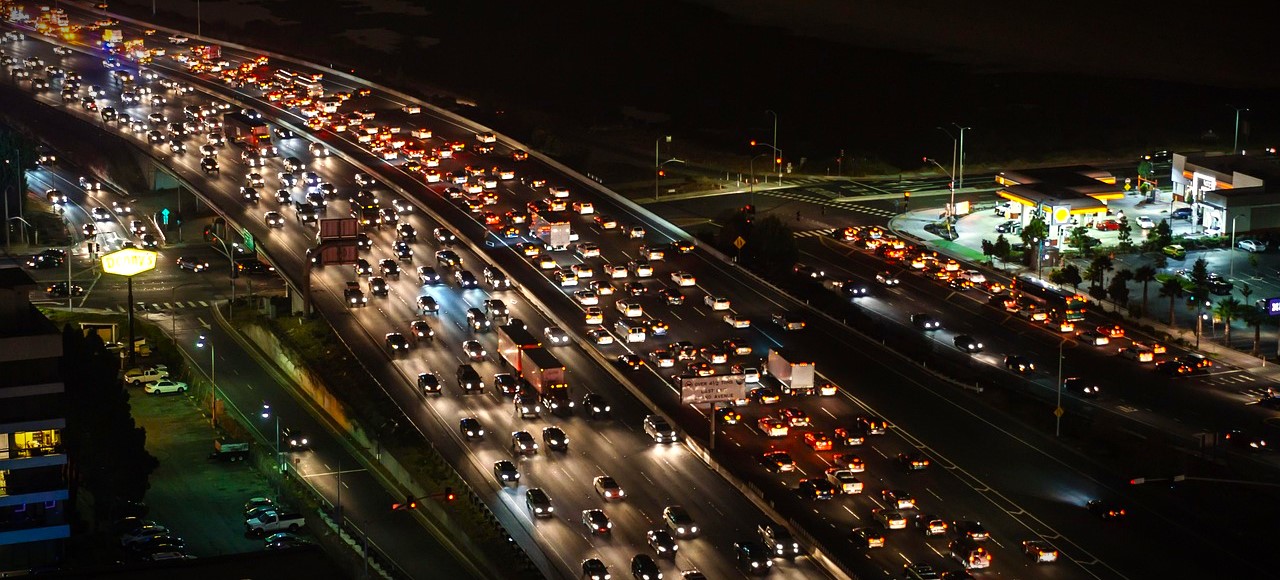
I LIVE IN Southern California, a little over 30 miles from my office. It’s almost all freeway, with five lanes running each direction most of the way. The commute each way typically ranges from 40 minutes to an hour and a half — though my personal record was over seven hours round-trip. That’s right: seven hours.
And that was with a carpool.
In the early hours of the morning, an asphalt tanker had overturned on the eastbound side, which slowed the westbound morning commute to a crawl as drivers gawked at the spectacle. The mess still hadn’t been cleaned up by the evening commute, forcing thousands of motorists off the freeway and onto surface streets. I felt bad for the people living in those neighborhoods; they could forget making a quick run to the grocery store, or anywhere else.
I avoid rush hour when I can. The commute can be mind-numbing; I try to stave off the boredom by listening to music or audiobooks. But even then, the drive can feel robotic. Every so often, I become aware of the ludicrousness of it all. Here are thousands upon thousands of people, crammed together side by side in what should be a wide-open road, all puttering along in the same direction in their smog-spewing mechanical contraptions.
Surely, this is not what God created the world to be?
But that’s my world. Millions of people who live in or near densely populated cities like Los Angeles take this way of life for granted. If you choose to live in suburbia, you are most likely choosing to commute. Yet we don’t experience commuting as a choice; it’s an inconvenient fact of life, a necessity.
And that raises a question: how many of our choices are like that?

AT THE END of the Sermon on the Mount, Jesus gives four warnings about the consequences of not heeding his words and putting them into practice. The first of these uses metaphors that his hearers would easily have related to and understood:
Enter through the narrow gate. For wide is the gate and broad is the road that leads to destruction, and many enter through it. But small is the gate and narrow the road that leads to life, and only a few find it. (Matt 7:13-14, NIV)
The imagery is consistent and straightforward. There are two gates, one wide and one narrow. There are two roads that lead from those gates: again, one is broad and one is narrow. Naturally, many people enter through the wide gate and travel the broad road. But only a few find and enter through the narrow gate and travel the narrow road that leads from it. Simple.
The question, though, is whether people realize where those roads lead. For only one of the roads leads to life; the other leads to destruction.

This is reminiscent of Psalm 1, the foundational psalm that sets the tone for the entire collection. The moral vision of Psalm 1 is that there are two paths in life. The first is the path of righteousness, which a person learns by meditating on God’s law. This is the way of blessing, which the psalmist describes in terms of a well-watered, thriving, and fruitful tree.
By contrast, there is also a path of wickedness, and the psalmist makes it clear where that path leads:
For the LORD watches over the way of the righteous,
but the way of the wicked leads to destruction. (Ps 1:6)
That basic moral picture permeates the Psalms. It’s there in the background of praise psalms, when the psalmist thanks God for the blessings that flow from obedience to Torah. And it’s there beneath the laments in which the poets complain that they’ve been faithful but are suffering unjustly. This is not the way it’s supposed to be, those psalms seem to say. Lord, do something about it!
Similarly, Jesus tells his hearers that they have a choice to make. He’s told them all about the nature of true righteousness and seeking the kingdom. Will they listen? How will they live? Will they go through the wide gate, walk the broad road, and live the way everyone else does? That’s the easy path, the one people take for granted without even thinking about it.
Or will they seek to find the narrow gate and travel the narrow road? Many fewer people do that. Indeed, it’s probably fair to assume that most of the people who heard Jesus preach throughout his ministry failed to do anything with what they heard. They may have had their hearts stirred. They may have marveled at his teaching and at his miracles. But in the end, that’s not enough. They needed to recognize the choices they had already made, the roads they were already walking, and where those roads were leading.
AGAIN, WE MAKE choices all the time, even if we don’t experience them as such. And every choice has its consequences. Some consequences are short-term and others are long-term. Turning again to a big-picture perspective, Jesus warns us about the eternal consequences of the choices we make today.
It’s not that there are always two choices in front of us, one good and one bad, one leading to life and the other to death and destruction. The point, rather, is that we need to first be aware that we have a choice, and second, make intentional choices that are in line with the eternity toward which we wish to strive.
What might that look like in practice? Let’s explore that in the next post, by going back to the ethical teaching of Jesus in Matthew 5. If we want to walk the narrow path that leads to life, how will we handle anger, covetousness, and the like? We have choices to make, and every choice counts.
 Squinting through Fog ("The Fog Blog")