

DID YOU EVER take an introductory psychology class in college? I took my first course in psychology sometime in the mid-1970s. That’s where I was first introduced to what’s known as Maslow’s hierarchy of needs, first proposed by American psychologist Abraham Maslow in 1943. I suspect that most students who have taken a similar course have heard of Maslow as well.
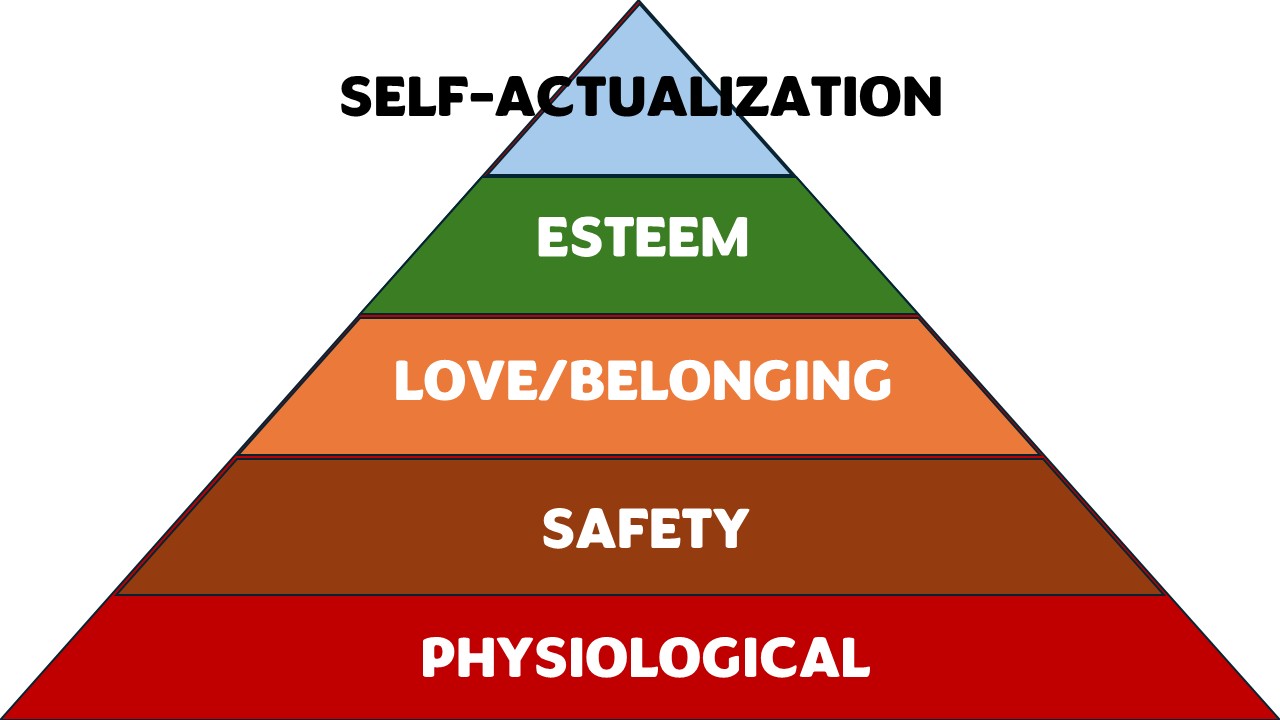
The hierarchy is usually illustrated as a pyramid with five levels, suggesting five different kinds of needs that motivate human behavior. The most fundamental needs have to do with bodily survival, with the things we literally cannot live without: food and drink, clothing and shelter, even sleep. Above those are the needs for safety, which can include physical, emotional, and financial security. Safety needs, in turn, are more fundamental than the need for love and belonging — and so on up the pyramid to the need for esteem and what Maslow called self-actualization, in which people move toward their full potential.
But the hierarchy isn’t meant to be taken too rigidly, as if it were a universal sequence of stages. More than one need can be activated at one time, and some will need to be revisited again and again. To me, however, the two main takeaways of the model are these. First, the more one’s needs have not been met — particularly the most fundamental ones — the more anxious a person will be. And second, it’s unrealistic and unfair to expect people to be their best selves when they don’t know where their next meal is coming from or whether they’ll have a safe place to sleep.
From that point of view, then, how should we read what Jesus says in the Sermon on the Mount? He repeatedly tells his hearers not to worry about basic needs like food, drink, and clothing. To encourage them to trust in divine providence, he draws their attention to the carefree life of the birds and the beauty of the wildflowers. If the Father takes care of these aspects of creation, he suggests, don’t they think he will take care of the humans who were created in his image?
Having said this, Jesus repeats the instruction to stop worrying:
So do not worry, saying, “What shall we eat?” or “What shall we drink?” or “What shall we wear?” For the pagans run after all these things, and your heavenly Father knows that you need them. But seek first his kingdom and his righteousness, and all these things will be given to you as well. (Matt 6:31-33, NIV)
Part of what Jesus says here seems to echo what he said earlier about prayer:
And when you pray, do not keep on babbling like pagans, for they think they will be heard because of their many words. Do not be like them, for your Father knows what you need before you ask him. (vss. 7-8)
Do you hear it? In both passages, Jesus first tells his hearers not to do what the pagans do, and then reminds them that they have a heavenly Father who already knows what they need.
But I wonder how Maslow would have reacted to what Jesus says. In telling his hearers to stop worrying about food and clothing and to wholeheartedly pursue God’s kingdom instead, is Jesus telling them — in Maslow’s terms — to pursue self-actualization despite being anxious about their survival needs? Wouldn’t that be a bit like walking up to people who are barely surviving on the street and telling them they should be maximizing their potential?
Yes. And no.
Here’s the “yes” part. As I’ve suggested before, Jesus wants his hearers to get the big picture. In the kingdom of heaven, there is more to life than just survival. Life is about more than food: as Jesus told his disciples, “My food is to do the will of him who sent me and to finish his work” (John 4:34). And the body isn’t merely something to be clothed and protected from the elements; it’s the blessed instrument through which we are able to do the Father’s will. So in a sense, yes, Jesus is pointing away from his hearer’s survival needs to their greater purpose.
But here’s the “no” part. When Jesus says not to chase after food and clothing the way the pagans do, he’s not saying that food and clothing don’t matter. Nor is he suggesting that to worry about such things is tantamount to being an unbeliever. The contrast he’s making isn’t between believers and unbelievers, but between those who have a gracious and trustworthy Father and those who do not. The one who created the world and all the glories of nature also created us. And as our Father, he knows and cares about what we need. When we truly understand that, we are freed from worrying unnecessarily about the things that anyone else in the world might worry about.
Because we aren’t just anyone else; we’re children of our heavenly Father.

WHAT I’M WANTING to avoid is any reading of Jesus’ words that makes his teaching lofty and ideal in a way that disregards the concrete reality of living in a body that has survival needs. As Maslow would insist and should be obvious to all, we need food, water, and clothing to survive — and when they become scarce, we become anxious. This is something we all share as members of the human race.
But Jesus isn’t saying that these things aren’t important and that we should therefore be more “spiritual.” God, after all, doesn’t ask the birds or the flowers to be more spiritual. Rather, Jesus knows and cares about what his followers need. Yes, he points them to heavenly bread, but first provides their earthly bread. Yes, his mission is to heal humanity spiritually, but people come to him because he also heals people physically in a way no one else can.
The question, then, is whether we can trust our heavenly Father enough to let go of needless worry, so that we can be free enough in spirit to make seeking his kingdom our top priority.
To do that, of course, we need to have a good sense of what it means to seek his kingdom in the first place. It’s not the top of the hierarchy, as if it were some kind of spiritualized version of Maslow’s self-actualization. It embraces the whole hierarchy, all of our needs, and reimagines them. Let’s explore that next.
 Squinting through Fog ("The Fog Blog")