

SOMETIMES, AT THE beginning or ending of a seminary class, I will invite a handful of students to pray out loud, knowing that in a few minutes I’ll give the final closing prayer myself. Initially, there’s almost always an awkward silence; people seem reluctant to be the first to pray. But sooner or later someone speaks, and then another, and another. Sometimes, I can hear something of their church traditions in their prayers, as when someone speaks of binding this or that spirit. Some people speak in highly personal terms, as if talking to a friend; some use more formal or even liturgical language.
And I’ve experienced how group prayer can differ markedly from one setting to another. Recently, before I took the stage to speak at a ministry conference, two of the conference leaders met to pray with me in the green room. They prayed one at a time. In another setting, before I preached to a more charismatic congregation, the whole pastoral staff gathered around me before the service to pray for me. They also prayed one at a time, but laid their hands on me as they did so. And in yet another setting, the staff stood in a circle around me and all prayed at once until the leader raised her voice above the din. That was the signal for the others to grow quiet while she finished the prayer.
All of that to say: prayer is not just a private and individual act but a public and communal one, and there’s no one “right” way to pray as a group. That said, we need to be wise and mindful, for when we pray in the presence of others, we can become self-conscious in a way that distracts us from communing with God.
I don’t want to treat this as cut and dried. I’m not saying that if we feel self-conscious praying aloud, then we should never do it. In fact, it can be good for our spiritual growth to learn how to focus our prayers while not letting our internal voices of doubt and criticism distract us. But that assumes, of course, that we’re wanting to pray in good faith and not being like the Pharisees Jesus condemned, where the hypocritical motivation is to impress others with our behavior.
The righteousness that embodies the kingdom of heaven is a matter of the heart, which God alone sees; it is not guaranteed by external appearances. A person may seem pious in public but not be righteous in private or in relation to others. Thus, in contrast with the hypocritical practice of praying publicly to be noticed and admired by others, Jesus counsels his hearers to pray in a private and secret way instead, a way that is strictly between them and God. Here are his words again:
And when you pray, do not be like the hypocrites, for they love to pray standing in the synagogues and on the street corners to be seen by others. Truly I tell you, they have received their reward in full. But when you pray, go into your room, close the door and pray to your Father, who is unseen. Then your Father, who sees what is done in secret, will reward you. (Matt 6:6, NIV)
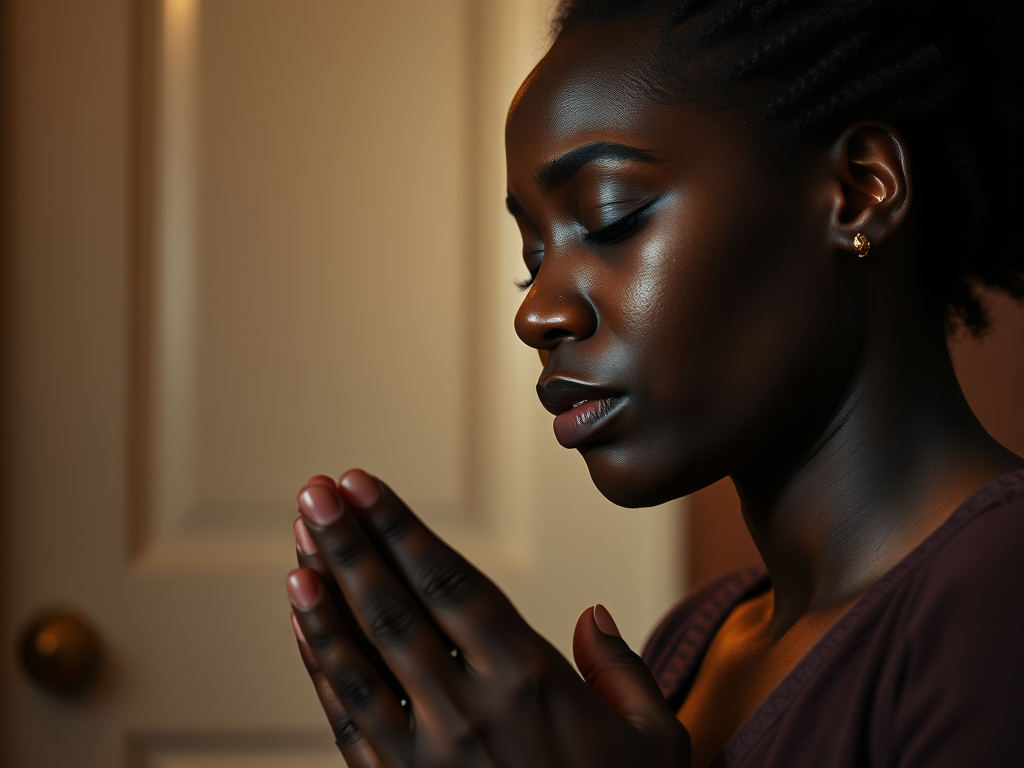
Matthew’s Greek has Jesus making a strong contrast with the hypocritical example of the Pharisees. He’s not just saying, “When you pray,” but, “You, when you pray…” Unlike those who pray in order to be seen by others praying, the righteous are to go into their room and pray so that only the Father sees. The word that’s translated as “room” is only used four times in the New Testament. In Luke 12:24, it refers to a place to store grain, but earlier in the same chapter, it refers to a private place where secrets are whispered (Luke 12:3).
Thus, it doesn’t have to be a particular room in the house; it could even be behind the wheel of your car when you’re sitting at a stop light (just please keep your eyes on the road). The point is privacy, to pray in a place where you can shut the door and be secluded from prying eyes and listening ears.
Jesus then repeats the same promise as before. If we will do this, if we will pray in a secret place where only God sees, God will reward us. Jesus does not, of course, specify what the reward would be. Perhaps he means that our prayers will be answered the way we hope, or perhaps we will simply be given the assurance that God is listening, whatever the response may be.
But to ask after the nature of the promised reward would miss the point, and risk throwing us right back into the realm of praying with ulterior motives. After all, the only thing that praying in private guarantees is that we won’t be doing it for the purpose of being admired by other people; it is not in itself a guarantee that our prayers will be righteous. Again, Jesus is not establishing a new set of behavioral rules or a checklist for righteousness, but overturning what the people have been taught by their religious leaders. He gives examples to point them in the right direction, and they need to work it out from there.

IT SHOULD GO without saying that there will always be a place for public and communal prayer in the Christian life. Again, Jesus himself prayed publicly, not only in the moments before raising Lazarus from the dead, but in front of over 5,000 people at once (Matt 14:19). And as we’ll see shortly, Jesus would hardly instruct his disciples to pray “Our Father” if he meant his disciples to only pray privately and individually. But we must always stay alert to the ways in which our desire or even need to be accepted and admired by others can derail the very purpose of prayer.
When we speak to God in front of others, we may feel the need to find more eloquent words than we would normally use, or to use the same Christian catchphrases as the people around us. We may be tempted to use group prayer as the opportunity to sneak in a mini-sermon, or make the point we didn’t get to make in an earlier discussion, or to have the last word in a disagreement. We can even use group prayer — heaven help us! — as a way of gossiping about the troubles of others under the cloak of pious concern.
By contrast, the most robust part of our prayer life will probably always be private. Many books have been written about how to pray, and you may find some helpful advice in them, but don’t expect to find a one-size-fits-all method. What matters is the spirit with which we come before God, wanting to both speak honestly and listen attentively.
But if we need a place to start, Jesus will give us one. We know it as the Lord’s Prayer or the “Our Father,” and we’ll take a look at that next.
 Squinting through Fog ("The Fog Blog")