

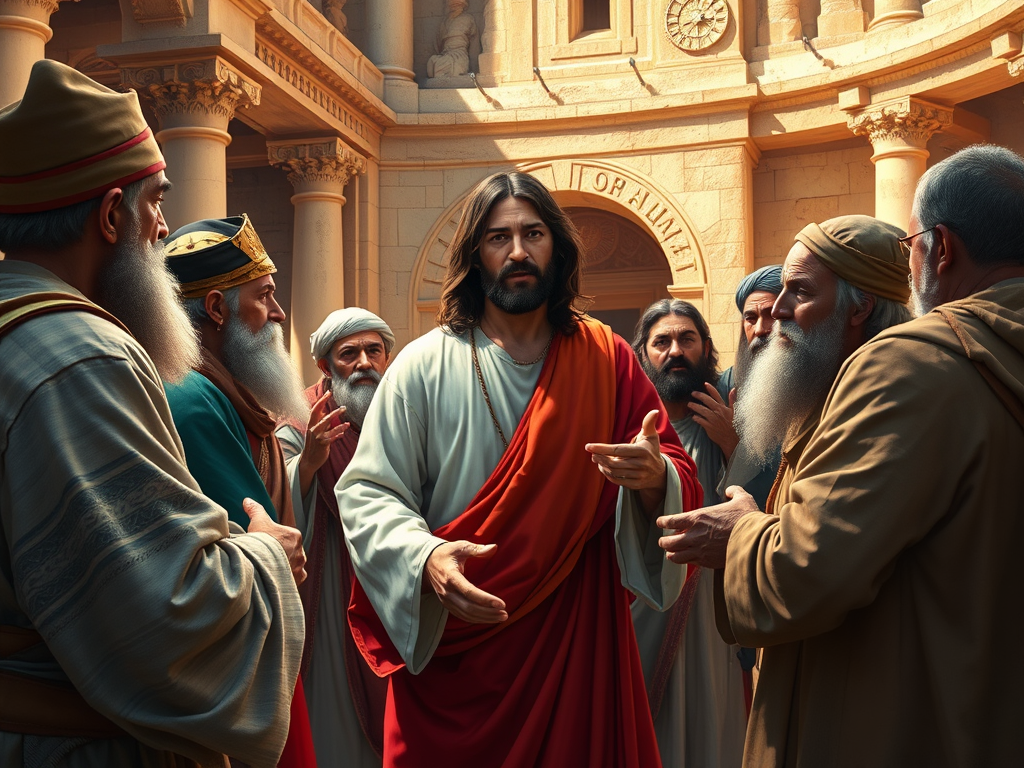
WE’RE PROBABLY USED to thinking of the Pharisees as sanctimonious, self-righteous hypocrites who picked a fight with Jesus everywhere he went. And surely, the closer we get to the end of the gospel of Matthew, the more this seems to be the case. During the last week of his life, for example, Jesus stood debating with the Pharisees and others in the crowded court of the Jerusalem temple. The Pharisees tried unsuccessfully to trap him in his words — and then were further embarrassed publicly when Jesus called them out on their hypocrisy and spiritual blindness.
But in Matthew’s gospel, Jesus’ first direct altercation with the Pharisees doesn’t actually happen until chapter 9. Up to that point, the Pharisees are only mentioned twice. The first is in chapter 3 when John the Baptist calls them snakes rather than hypocrites. And the second, as we’ve seen, is in the Sermon on the Mount, when Jesus tells his listeners that if they want to be part of the kingdom of heaven, they’re going to have to be righteous in a way that surpasses the Pharisees and the teachers of the Law.
The rest of chapter 5, then, is commentary on that shocking statement. In essence, Jesus repeatedly tells his audience, “Here’s an example of something they’ve taught you about righteousness — and here’s what I’m telling you instead.” Take, for example, the matter of oaths. As we saw last time, Jesus told his hearers,
Again, you have heard that it was said to the people long ago, “Do not break your oath, but fulfill to the Lord the vows you have made.” (Matt 5:23, NIV)
In principle, there’s nothing wrong with teaching people that if they make a promise to God they should keep it. But Jesus surprises his hearers again by seeming to contradict what they were taught:
But I tell you, do not swear an oath at all: either by heaven, for it is God’s throne; or by the earth, for it is his footstool; or by Jerusalem, for it is the city of the Great King. And do not swear by your head, for you cannot make even one hair white or black. (vss. 34-36)
Let me say right up front: I don’t think that on the basis of this verse Christians today must refuse to take oaths such as those that may be required in a court of law. In context, Jesus isn’t saying that swearing an oath is a bad thing in itself, an evil practice that must be eliminated. Rather, his words suggest that the practice has become a hypocritical one under the teaching of the Pharisees, and the righteousness of the kingdom demands something else.
This teaching is similar to the one we saw from Matthew 23, when Jesus was criticizing the Pharisees for their hypocritical approach to oaths, in which the spiritually superficial focus was on getting the wording right. In a manner reminiscent of that passage, Jesus seems to be arguing here in chapter 5 that whether you swear by heaven, or earth, or Jerusalem, it’s all tantamount to swearing by God, because everything belongs to God and is part of his sovereign domain — right down to the hairs on your own head.
And why does that matter? Again, it’s because the Pharisees and the people knew that the Ten Commandments forbade God’s people from misusing his name. The implication of Jesus’ words is that you can’t duck responsibility for a vow on the basis of a religious technicality.
We see something very much like this in the gospel of Mark. Jesus criticizes the scribes and Pharisees for the way in which their traditions contradict the Law of Moses. Apparently, people were able to make a vow dedicating their resources to the temple — in a way that allowed them to not have to help their parents, a direct violation of the commandment to honor their mother and father. Jesus was unsparing in his condemnation of the practice:
You have a fine way of setting aside the commands of God in order to observe your own traditions! … Thus you nullify the word of God by your tradition that you have handed down. And you do many things like that. (Mark 7:9,13)
Thus, in the Sermon on the Mount, when Jesus addresses the Pharisaic tradition surrounding oaths, he tells the people what true righteousness entails:
All you need to say is simply “Yes” or “No”; anything beyond this comes from the evil one. (Matt 5:37)
Later, Jesus’ brother, the apostle James, would teach something nearly identical:
Above all, my brothers and sisters, do not swear—not by heaven or by earth or by anything else. All you need to say is a simple “Yes” or “No.” Otherwise you will be condemned. (James 5:12)
The kind of righteousness that befits the kingdom of heaven, in other words, is one in which people say what they mean and mean what they say. They don’t try to weasel out of commitments by hiding behind ambiguous language and saying things like, “Well, I didn’t really promise…” Instead, they are trustworthy and reliable; if they say they will do something, you know they will do it.
Isn’t that the kind of salt and light our world needs?

ALL OF US have suffered broken promises. Perhaps, for example, we’ve done business with people because we saw the fish symbol on their business cards and ads — only to be disappointed in their lack of integrity. Or we took a job believing that we would be doing one thing, only to find ourselves doing something very different, something we never wanted to do. Or we felt betrayed by a spouse or parent who promised again and again to change, then always fell back into the same hurtful behavior.
But if we’re being honest, we may also have to admit that we’ve broken promises to others. Perhaps, as Jesus has already suggested in the sermon, we failed to take our wedding vows as seriously as we should have. Or perhaps we knew that someone wanted something from us and said whatever we needed to say to get them off our backs — then tried to find some excuse later to renege on what we said, or just plain walked away.
I know: there can always be misunderstandings based on miscommunication. Someone may hear a promise where none was intended. But if we truly want to be the kind of people who embody the kingdom of heaven the way Jesus taught, we need to take personal responsibility for our part of the communication. We can do our best to be clear about our intentions — even if what that means in practice is letting people know honestly when we’re unsure about something.
The point is that others need to know that when we say “Yes,” they can trust that it truly means yes, and when we say “No,” it means no. As Jesus suggested earlier in the sermon, it’s the vocation of every believer to let their light shine in this darkened world in such a way that others would see how we live and then glorify God because of it. So to put it bluntly, how will others know that God’s word can be trusted if ours cannot?
 Squinting through Fog ("The Fog Blog")