
THESE DAYS, TO some extent, Thanksgiving Day is a bit wistful for me. For years in our small extended family, I was always the one responsible for roasting the turkey. Sometimes, that also meant that I was the one responsible for delaying the festivities, too, as I waited impatiently for the bird to get to the right temperature. But those days of feasting with family are in the past now. Both of my parents are gone, and for various good reasons, most everyone else has moved away.
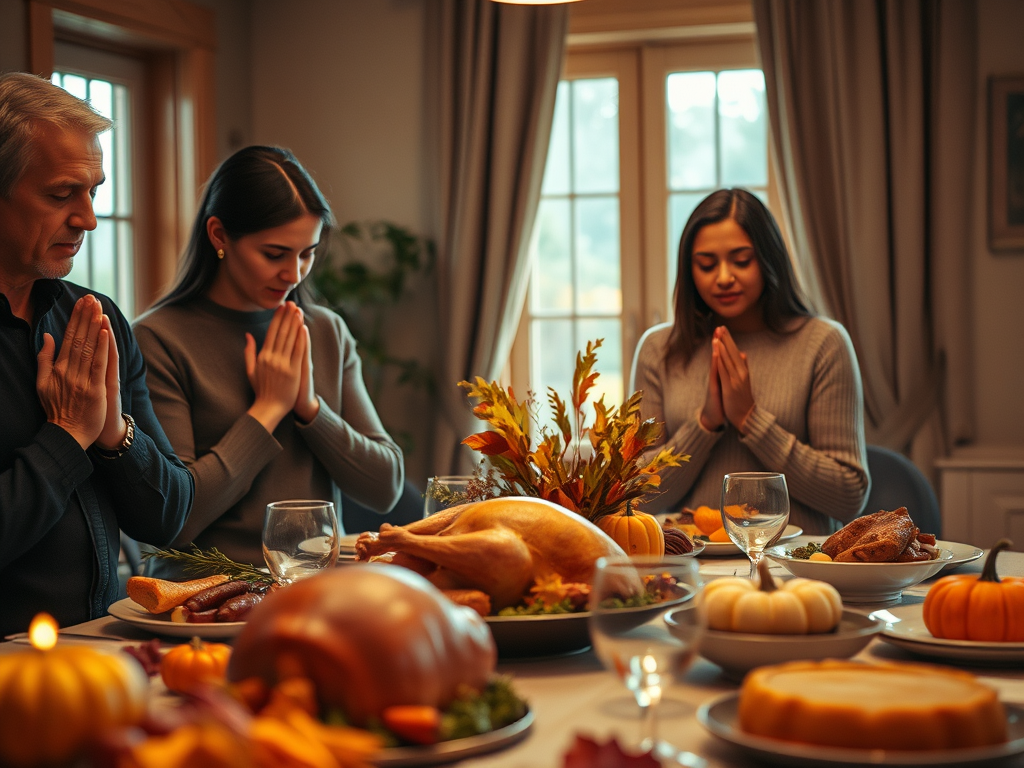
In all honesty, though, holiday traditions can be a lot of work, even stressful. Surely that’s not news to anyone. For example, I don’t miss preparing, babysitting, and carving a turkey (although I wouldn’t mind having one of those incredible pots of turkey stock that come from the carcass!). I don’t miss trying to figure out how to fit everyone in our cramped dining room when it was our turn to host. I don’t miss the clean-up after everything is done and the guests have gone.
But somehow, I still miss the tradition itself. It feels a little like having a page turned for you when you haven’t quite finished reading the chapter. And there’s no going back.
Well, things change. Life goes on.
And if I’m being really honest…I was never terribly fond of the occasional ritual of going around the table and having each person say what they’re thankful for. It always felt a bit artificial — like when your mother forced you as a kid to mumble “Thank you” to Aunt Minnie for buying you an ugly sweater you didn’t want and would never wear. It’s the polite thing to do, of course, and no one wants to make Aunt Minnie mad. And don’t get me wrong: I definitely would not want a world in which parents never taught their children manners!
But authentic gratitude can neither be manufactured in a moment nor limited to a yearly ritual. It’s a habit to be cultivated all year long.
Consider, for example, the words of the apostle Paul:
Rejoice always, pray continually, give thanks in all circumstances; for this is God’s will for you in Christ Jesus. (1 Thess 5:16-18, NIV)
One way to read the text would be from the standpoint of the kid who has Aunt Minnie looming over him, waiting. In that light, “God’s will” is what we are obligated to do for our heavenly Father to give us his nod of approval. Constant rejoicing, praying, and thanksgiving become three religious behaviors that we are commanded to practice if we want to get it right as disciples. The words “always,” “continually,” and “in all circumstances” sound like we need to watch out for slip-ups, lest we get divinely smacked in the back of the head. Hey, you down there. Yes, you. I haven’t seen much joy from you lately. I know you’ve just been diagnosed with cancer. But you’re supposed to be a joyful Christian, remember?
But there’s another way to read Paul’s words. God’s will is not simply what God wants from us. It’s what God wants for us. God has made us for a life of communion with him through a habitual posture of prayer. He wants us to know the joy and gratitude that flows from that way of living.
In a sense, the two readings aren’t mutually exclusive. The first reminds us that we need spiritual discipline in a way that’s similar to how kids need to be taught to be mindful of others. Because we live in a thoroughly secular world, our habits and attitudes must be trained. Bad news and difficult circumstances are not joyful, nor do they typically inspire thanks. But submitting ourselves humbly, intentionally, and repeatedly to the discipline of prayer helps us learn, little by little, to see beyond our circumstances to the loving and gracious God who holds our ultimate destiny.
Without the second reading, however, the first can deteriorate into legalism and shame. God becomes more demanding than loving. We feel compelled to act joyful, to put on a mask of gratitude to hide the pain. That’s not the same as patiently seeking gratitude through the pain, seeking the presence of God in the pain.
And in case it needs to be said: I don’t think Paul is telling us to “count our blessings,” at least not in the way this is usually done. Counting our blessings can be a kind of attitudinal accounting: look at all the positive things in your life and add them up. Does the total come out to be more than the sum of the bad things? If so, congratulations, you can be grateful! If not, well, you’d better keep looking. Maybe that sweater isn’t as ugly as I thought?
Moreover, what we tend to categorize as “blessings” may be the same things anyone else would, whether they believe in God or not: health, family, material wealth, you name it. That’s why texts like the Beatitudes in Matthew 5 or Jesus’ blessings and woes in Luke 6 are so counterintuitive: Jesus says that the poor and hungry, as well as those who mourn and weep are blessed. In this world, who in their right mind would count these things on the “blessing” side of the ledger?
No, Paul is putting something else before us. He’s not telling us to count our blessings. Nor is he saying that we should be thankful for all the ways life may feel fractured and bent. Being grateful in all circumstances is not the same as being grateful for all circumstances. Paul himself wasn’t grateful for all the things he suffered for the sake of the gospel. Instead, he was grateful to never have to suffer alone. He was grateful to have God’s strength even in his moments of greatest weakness.
God wants so much more for us than what we often settle for, especially when we live reasonably happy and comfortable lives by worldly standards. He wants us to have hearts of gratitude and joy no matter what the circumstances. And we get there, if at all, through the habit of prayer.
That’s my prayer for you. Indeed, it’s my prayer for me. Enjoy your Thanksgiving Day celebrations, whatever they may be, whether it’s a turkey with all the trimmings or a box of mac and cheese, whether your gathering is large, small, or not at all. Because God wants us to know true joy and gratitude in all circumstances, not just for a day, but for a lifetime.
And that in itself should be cause for thanks.
 Squinting through Fog ("The Fog Blog")