

AS WE’VE STUDIED 1 John, I’ve repeatedly referred to the situation behind the letter as a “church split.” That’s what we would call it today, though the churches of John’s day would have been quite different from our own. Churches first met in private homes rather than public spaces; even some early synagogues were like this. Later, as the church grew, believers began to meet in structures that had started as homes and had been repurposed for worship gatherings. The kinds of structures we now associate with the word “church” came still later, getting a boost when Christianity was officially sanctioned by Emperor Constantine.
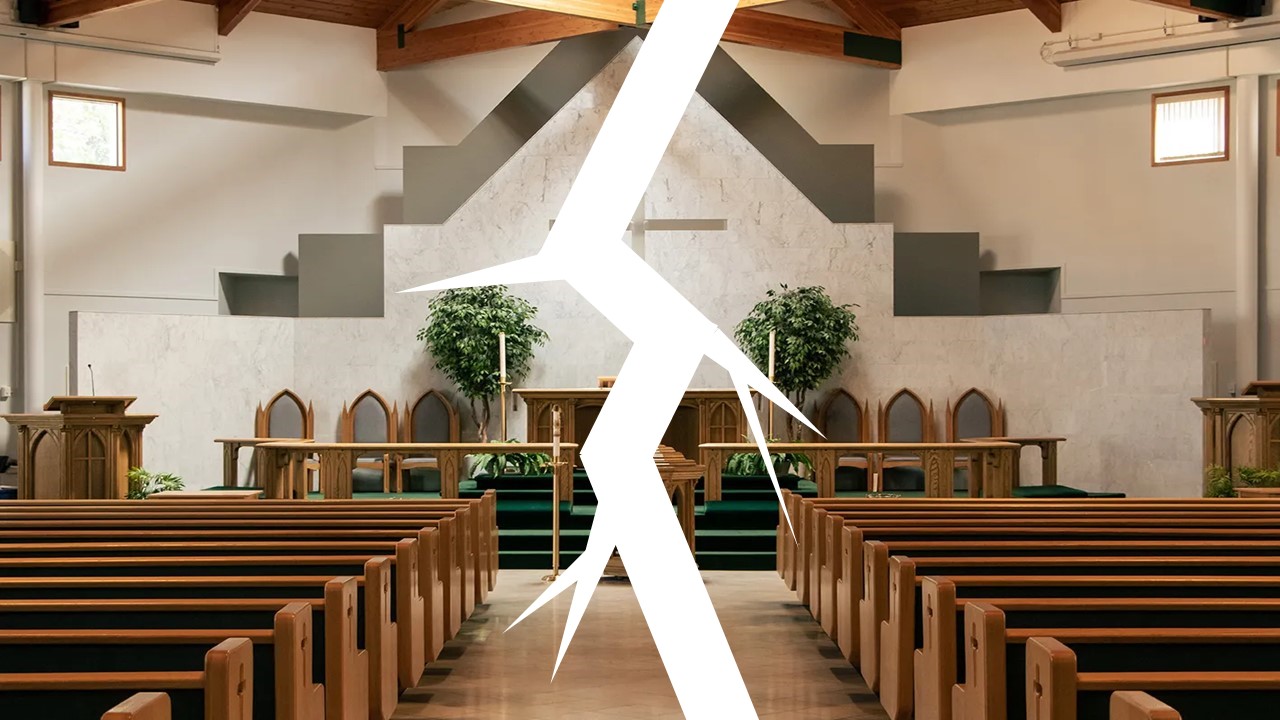
We don’t know what John’s community was like, but it was probably a collection of simple house churches. We also don’t know if the split occurred within such house churches, between them, or both. But whatever happened, it was likely to have been both confusing and painful to the parties involved. At some point, the folks we’ve been calling secessionists packed their bags and left.
Something similar still happens today. When churches split — perhaps polarizing over some matter of doctrine, policy, or personnel — the controversy typically escalates to the point where people leave, and not on good terms. They still see themselves as being in the right, and may go in search of another congregation where people “get it.” And even some of the people who remain may have sympathies with those who left.
We’ve had to use a little imagination to reconstruct the situation in John’s community, making inferences from what he writes in 1 John and what we know of human nature. What we can infer from 2 John, then, is that the problems didn’t end when the secessionists left. Things may have calmed down a bit for the folks who remained in John’s community, especially after he wrote to reassure them with full apostolic authority and credibility that their destiny was secure. But the secessionists, of course, didn’t disappear off the face of the planet; they went to other communities. What happened then?
You may never have experienced a church split yourself; I’m happy to say that I’ve never been through one. But I’m sure you can easily imagine how the people who leave a congregation angry or disgruntled have a story to tell. Let me be quick to say that unlike the situation addressed by John’s letters, when people today leave a congregation they may be in the right, especially when the reason is an abuse of pastoral authority or clear heresy. It is possible to leave for good reasons and with a clear conscience, especially when honest attempts at mutual understanding and reconciliation have been made.
But whatever the reason for leaving, those who depart don’t say to themselves, “They’re right and I’m wrong, so I’d better go.” Rather, they’re firmly convinced that they’re in the right. Moreover, they may want someone to listen with a sympathetic ear to their side of the story. Today, that might mean taking to social media. And if the controversy was a doctrinal one, they might use such media as a way of spreading their views. They’re looking, in other words, for a platform.
The people of John’s day, of course, didn’t have Internet. News was spread by word of mouth. Teaching, whether true or false, was mostly done by face-to-face conversation and public oratory. Can you imagine then that the secessionists, having failed at convincing John’s readers to come around to their way of thinking, went seeking not just another fellowship but another platform for their teaching?
The secessionists, remember, probably thought of themselves as Christians, perhaps even Christians with a superior kind of enlightenment compared to the people who remained in the community. But to the apostle John, they were false prophets, because they refused to believe that Jesus had come in the flesh, and tried to convince others to follow them. Unlike some other possible doctrinal differences, this was not an agree-to-disagree issue; to John, without the full physical humanity of Jesus, there was no gospel.
But obviously, the secessionists hadn’t changed their minds about Jesus. And given our human need to prove ourselves right, chances are they went looking for someone else to proselytize.
This seems to be the situation behind the letter we know as 2 John, which in terms of word count is one of the shortest books in the Bible. Because we’ve spent a good deal of time in 1 John, the themes and language of 2 John should sound familiar. The apostle begins by emphasizing Jesus’ command to love one another. But having said this, he quickly turns again to the language of “antichrists” — where again, the issue is that there are people who refuse to “acknowledge Jesus Christ as coming in the flesh” (vs. 7, NIV), and don’t keep their opinion to themselves.
John wrote his second letter because false teachers had been spreading such heretical views, contrary to the apostolic gospel. The letter hints that the people doing so were those who had left John’s community after the split. John is deeply and rightly concerned about how such teaching might undermine the spiritual health and vitality of the church, which was still in its infancy and had no New Testament upon which to rely.
His words about such false teachers, therefore, may sound harshly insistent: “Do not take them into your house or welcome them” (vs. 10). This is not meant to be a personal attack — Get lost, reprobate! But John wants to make sure that the Christian community doesn’t open its house churches to false teaching. To do so, he says, is to collude in the “wicked work” (vs. 11) of the false teachers.
We’ll do a deeper dive into the letter shortly. But for now, it’s important to hold the two parts of the letter together as we read. John means what he says when he tells his readers that they must obey Jesus by walking in love. But as we’ll see, he also emphasizes walking in truth. We should not suppose that in standing so firmly for the truth about Jesus, and directing others to do likewise, John was being unloving. Having been with Jesus himself, having watched the ups and downs of the newly birthed Jesus movement, he probably knew better than anyone what was at stake in diluting or changing the gospel message.
That’s still the challenge for us. In a pluralistic world, we may experience the tension between truth and love. How well do we navigate that tension? We need first to understand what’s essential to the gospel. Knowing this, we need to stand for the truth. But controversy breeds anxiety, and when we’re anxious, it’s hard to be loving and easy to go into attack mode. This is surely not what John would want. If and when we must take a stand, we must always, always do so in love.
 Squinting through Fog ("The Fog Blog")