

THE DISCIPLES WERE understandably troubled and confused. Jesus had already startled them by washing their feet, an unexpected and probably unwanted demonstration of humble service. Then Jesus became agitated and announced that one of them would betray him. The startled disciples silently exchanged glances around the room: Which of them would do such a thing? Who could the traitor possibly be?
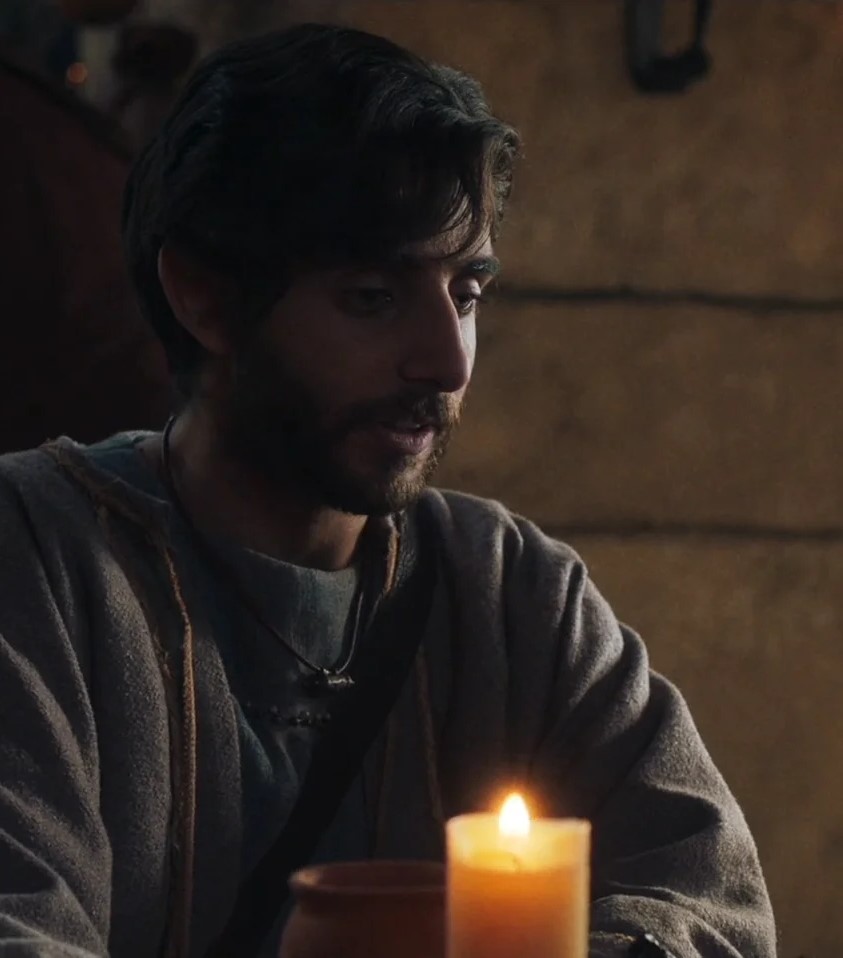
I sometimes picture Judas hearing Jesus’ words and frantically calculating what he should do. Confess? Pretend to be as shocked as everyone else? And wait, I imagine him thinking, does Jesus already know it’s me?
Judas, obviously, did not confess but played along. He probably didn’t notice the silent communication between Peter and John, who was reclining next to Jesus. Peter raised his eyebrows at John and nodded his head in Jesus’ direction, as if to say, “Go on, ask him. Ask him who the traitor is.” John leaned back and whispered, “Who is it, Lord?” Nobody else, apparently, heard Jesus’ reply. They thought nothing of Jesus dipping a piece of bread and then handing it to Judas. They were still completely clueless as to Judas’ intentions when he left the room.
But John, of course, knew. And here’s how he retells his memory of what happened:
As soon as Judas took the bread, Satan entered into him. …He went out. And it was night. (John 13:27, 30, NIV)
“And it was night.” That’s not a time stamp, as if John were saying nothing more than “It was about 9 PM.” The theme of light versus darkness runs through his entire gospel. Think of the Fourth Gospel as a movie. The contrast between light and darkness shows up not only in the dialogue and voice-over narration, but in the way each scene is lit to set the mood. In that sense, the night into which Judas disappears reflects the darkness of his lost and misguided soul.
Or go back to an earlier story in John’s gospel. Remember that John begins the overarching narrative by declaring Jesus to be the eternal Word, the one through whom all things were created. He then describes Jesus as the “true light,” coming into a darkened world:
In him was life, and that life was the light of all mankind. The light shines in the darkness, and the darkness has not overcome it. …The true light that gives light to everyone was coming into the world. He was in the world, and though the world was made through him, the world did not recognize him. (John 1:4-5,9-10)
Now jump ahead to chapter 3, in which Nicodemus the Pharisee comes to Jesus under the cover of night. Here, the darkness itself is a reminder of the opposition to Jesus that forces Nicodemus to hide his movements. It may also reflect the benighted ignorance for which Jesus chides Nicodemus in verse 10: “You are Israel’s teacher, and do you not understand these things?”
And it’s in this context that we read these words just a few verses later:
Light has come into the world, but people loved darkness instead of light because their deeds were evil. Everyone who does evil hates the light, and will not come into the light for fear that their deeds will be exposed. But whoever lives by the truth comes into the light, so that it may be seen plainly that what they have done has been done in the sight of God. (John 3:19-21)
It’s not clear whether these are Jesus’ words or John’s; different translations put the quotation marks in different places. What is clear, however, is that this way of speaking dovetails with the language and vision of John’s gospel more than it does with the other three. For John, light represents goodness and truth; darkness represents evil and ignorance. And Jesus, the eternal Word, is himself the light of the world (John 8:12).

IT SHOULD COME as no surprise, then, that one of the most foundational declarations of his letter is that God is light. Here’s how he says it in 1 John 1:5:
This is the message we have heard from him and declare to you: God is light; in him there is no darkness at all.
As we’ll see, it may be that what John wrote in his gospel about God and light was itself the basis of the misinterpretation and false teaching that made it necessary for him to write the letter. But here, he doesn’t back down from the language; he doesn’t say, “Okay, let me try a different metaphor.” Even in the face of possible misunderstanding, he doubles down on the declaration. God is light, without qualification. And because God is light, there cannot be a speck of darkness in him.

Such a statement shouldn’t be a surprise to anyone familiar with the Old Testament. Think, for example, of the creation story in Genesis. The first order of business in creation — which therefore was the first order of business, period — was to create light in the darkness and separate the two. Or think of the different ways God revealed himself to his people: how many of them involved some form of light? He appeared to Moses in a burning bush. He led his people through the wilderness in a pillar of fire in the darkness. He came in fire and lightning atop Mount Sinai. His glory was reflected in the glowing face of Moses.
Or consider all the ways God is portrayed in terms of light in the Psalms. Psalm 76:4 declares that God is “radiant with light.” Psalm 104:2 says that God is wrapped in light as one might wear a cloak. In Psalms 4, 44, and 89, the psalmist prays or longs for the light of God’s face or presence. In several psalms, light is associated with life and salvation. Similarly, God’s light reveals sin (Ps 90:8), and repeatedly, the psalmists insist that those who want to follow God’s path must learn to walk in God’s light, as in Psalm 119:105: “Your word is a lamp for my feet, a light on my path.”
That last idea is particularly important for John’s purposes. He’s not writing a poem; the statement that God is light isn’t just a picturesque metaphor. Rather, as we’ll see, the statement carries a moral imperative: if we claim to believe in and serve a God who is light, then we must not walk in darkness.
 Squinting through Fog ("The Fog Blog")