

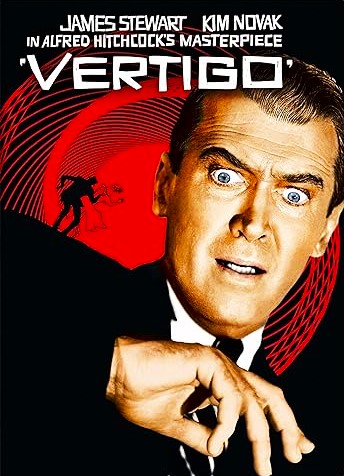
HAVE YOU EVER seen the classic 1958 Alfred Hitchcock thriller, Vertigo? In it, Jimmy Stewart plays a former police detective named Scottie Ferguson, who retired from the force after a tragic incident left him with a crippling fear of heights. There’s a climactic scene in which Scottie must run up the stairs inside a bell tower (for you trivia buffs, it’s the Mission San Juan Bautista in California). His vertigo increases with every step. Nervously, he glances back down the stairwell behind him — and it seems to distort, giving the dizzying illusion that he’s climbed dangerously higher than he actually has.
Moviegoers watching that scene for the first time found themselves as dizzy as Scottie. And that, of course, was what Hitchcock wanted.
Cinematic history was being made. It was first use of what is now known as the dolly shot — or as some fittingly call it, the “Vertigo effect.” You’ve seen it in other films, from Jaws to The Lord of the Rings to Pixar’s The Incredibles. Imagine a close-up of a character’s face; suddenly, while the face stays the same size, the background behind the character seems to recede into the distance, giving the disorienting illusion that something that shouldn’t be moving is rushing away from you. The trick is to put the camera on a dolly and move it backward while simultaneously keeping the lens focused on the character’s face and zooming in.
To me, it’s a good metaphor for the different ways that the four gospels begin the story of Jesus. All the gospels, of course, focus on Jesus as their main subject. Mark and Luke pull the camera back to include John the Baptist; Matthew pulls back to give us the backdrop of Abraham, David, and the exile. But John, as we’ve seen, pulls back furthest of all. He stays focused on Jesus but pulls the camera back to show us a dizzying cosmic vista in the background. Jesus is the eternal Word, the agent of creation itself:
Through him all things were made; without him nothing was made that has been made. In him was life, and that life was the light of all mankind. (John 1:3-4, NIV)
And again, we hear the echoes of these words at the beginning of 1 John as well:
That which was from the beginning, which we have heard, which we have seen with our eyes, which we have looked at and our hands have touched—this we proclaim concerning the Word of life. The life appeared; we have seen it and testify to it, and we proclaim to you the eternal life, which was with the Father and has appeared to us. (1 John 1:1-2)
John gives reliable eyewitness testimony to Jesus. But the full truth about Jesus — whom John calls “the Word of life” — can’t be seen by the naked eye. We can see the fruit of God’s creation all around us, but no one has seen the original divine act of creation. We can see living things, but not life itself. In the man Jesus, however, John sees the Word, eternally with the Father. In him was light; in him was life.

JOHN’S LANGUAGE AND imagery can’t be reduced to the concrete “facts” of journalism. (Well, even those facts are less concrete than we might like to think, but that’s another story.) The closer we push to divine reality, the more we stretch beyond the limits of human imagination and the more our words and metaphors will fail us. And that’s as it should be, unless we prefer to settle for gods that are made in our image.
This is important for how we understand the gospel. When John says “we proclaim to you the eternal life,” I suspect many of us go straight to the good news that Jesus makes it possible for us to go to heaven and live there forever. And that’s fine, as far as it goes.
But does it go far enough? Does it go as far as John himself wants to take us?
Too often, I think, our perspective is too limited. We focus in on life and work of Jesus, then pull the camera back far enough to see Jesus in the context of our own lives, perhaps even far enough to encompass our own personal eternal destiny.
Understanding what John means by “eternal life,” requires a wider angle of view. In the New Testament, to describe life as “eternal” is not just about the quantity of life but its quality. It’s not just about how much life, but what kind of life Jesus gives.
We tend to think of eternal life as the promise of unending life for each of us in the future. But John pulls back to encompass the past — the far, far distant past. John focuses the lens on the man Jesus, but draws back to show us the Word of life, the Son who was eternally with the Father. And yes, that Word appeared in human form.
But he didn’t simply come to deliver the gift of eternal life as Amazon might deliver a box to our doorstep. Rather, I take John as saying that Jesus came to draw us into his life, the life he already had eternally with the Father.
Can you imagine it? Really, it’s enough to give you vertigo.
 Squinting through Fog ("The Fog Blog")