

WHEN YOU THINK of cinematic portrayals of Moses, what movie comes to mind? For people of my generation or a little before, it would probably be the 1956 classic, The Ten Commandments, starring Charlton Heston. But in 1998, Dreamworks released the animated film The Prince of Egypt, which tried to reimagine the biblical story. In that version, Moses grows up in Pharaoh’s household alongside Rameses, who would grow up to be the next Pharaoh. The confrontation between Moses and Pharaoh, in other words, was a battle between brothers.
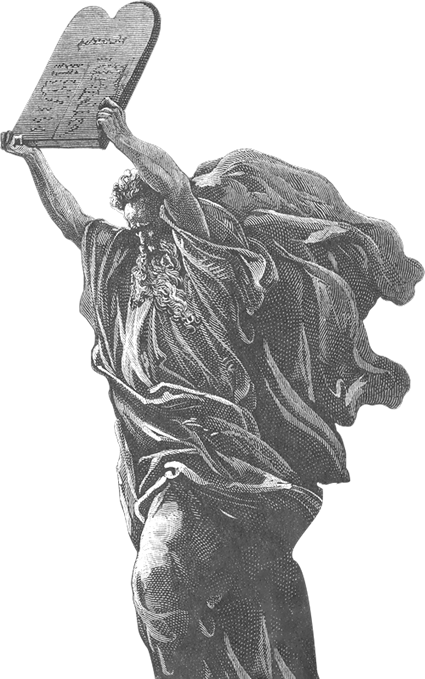
At the end of the film, Moses comes down Mount Sinai with the stone tablets and looks out upon the sea of Israelites before him. It’s portrayed as a triumphant moment. The music swells and the end credits roll. But people familiar with the biblical tale know better. Sadly, the masses celebrating on the plain below have already fallen into idolatry and are worshiping a golden calf. Furious, Moses dashes the tablets to the ground. God is angry, too, and threatens not to go with them the rest of the way to the Promised Land.
Only because of the intervention and pleading of Moses does God relent. Moses cuts two new tablets and goes back up Mount Sinai, where God has agreed to let his glory pass in front of Moses. God comes in the cloud and declares these famous words:
The LORD, the LORD, the compassionate and gracious God, slow to anger, abounding in love and faithfulness, maintaining love to thousands, and forgiving wickedness, rebellion and sin. Yet he does not leave the guilty unpunished; he punishes the children and their children for the sin of the parents to the third and fourth generation. (Exod 34:6-7, NIV)
Any true understanding of God has to hold these things together: both his righteous anger at sin and his loving grace and forgiveness. As uncomfortable as we may be at the idea of punishment for sin, we can’t truly appreciate the meaning of God’s holiness, grace, and forgiveness without it.
As a prophet, Micah has the often unenviable task of speaking on behalf of God to his people. The words are often angry ones, words of judgment and condemnation. But punishment is not the end of the story. Micah also brings words of grace, mercy, and a future hope. We’ve seen how the final chapter of Micah moves steadily from Micah’s lament over Judah’s moral decay, to his own personal hope, to a repentant Jerusalem’s hope that someday things will go back to the way they were in the old days. The book then ends with what reads like a communal prayer to God, a hope-filled prayer praising God for his love and faithfulness:
Who is a God like you,
who pardons sin and forgives the transgression
of the remnant of his inheritance?
You do not stay angry forever
but delight to show mercy.
You will again have compassion on us;
you will tread our sins underfoot
and hurl all our iniquities into the depths of the sea.
You will be faithful to Jacob,
and show love to Abraham,
as you pledged on oath to our ancestors
in days long ago. (Mic 7:18-20)
Back at the beginning of our study, we noted that the name “Micah” may be a shortened form of the name “Micaiah” — which means, “Who is like God (Yah)?” Thus, it’s fitting to end this collection of Micah’s prophecies with a prayer that begins with the worshipful question, “Who is a God like you?”
And in sharp contrast with the arrogance for which the people stood condemned, the prayer has a notably penitent and humble tone, acknowledging their sin, transgression, and iniquity. These three words for sin, variously translated in different English versions, possess different nuances that in combination give a well-rounded description of the wrongdoing confessed. Taken together, the words suggest that the people have not only done things that are evil in God’s sight, but in so doing they have rebelled against God and failed to live up to the righteous standard to which they were called.
Again, though, guilt and punishment are not and cannot be the end of the story. In this prayer, in the references to God’s mercy and faithfulness, you can hear echoes of Exodus 34:6; the word translated here as “mercy” is the same word translated as “love” in the Exodus passage. These two Hebrew words, hesed and emeth, mercy and faithfulness, often appear together in the Psalms to declare the rock-solid, trustworthy character of God. God remains faithful to his covenant promise even when the people have failed to keep up their end of the relationship.
But…
In the vision of the prayer, there is only a “remnant” of the people left. The very idea is filled with loss and mourning. The people were supposed to be God’s “inheritance,” his special possession forever. And now? Those who are left, perhaps those have returned from exile to face new challenges, don’t consider themselves to be lottery winners or the so-called “lucky” few. They haven’t won anything; they haven’t even earned the right to return. Were it not for the compassion of God, were it not for God’s willingness to forego anger for mercy, they might have remained in exile forever. Any celebration of their return from exile, therefore, must be done with humbled and broken hearts.
. . .
I DON’T KNOW how long such a prayerful attitude might last. Way back in the days of Moses, before the people crossed the Jordan to take possession of the land of Canaan, he had warned them: Don’t forget. Don’t take this gift for granted. Don’t forget how you got here, how you wouldn’t be here if not for God’s faithfulness to you. Fast forward, then, to the prophecies of Micah: the people did forget, not in the sense of being unable to remember or tell the ancient stories, but in the sense that the old stories no longer had any bearing on how they lived.
But in this prayer, at least for a time, the people remember.
 Squinting through Fog ("The Fog Blog")