

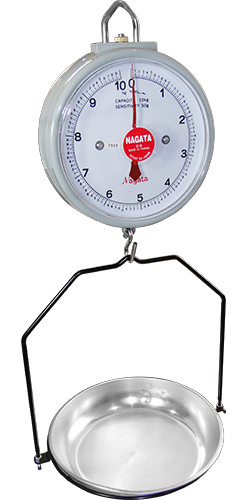
LIKE MANY PEOPLE, my wife and I buy our groceries from more than one store, and these stores don’t all do things the same way. At one of our favorite stores, produce is sold by the unit: you pay a fixed price for each banana or potato, regardless of size (and of course, I try to get the biggest ones I can for the money). At other stores, they’re sold by the pound, and there may be scales hanging in the produce section to let you know how much you’re buying. Prepackaged items like meat and poultry already come with a label telling you the weight.
Here’s the thing: how do you know those numbers are accurate? We simply take it for granted that if the label says we’re buying a 3.4 pound chicken or a 2.6 pound tray of ground beef, that’s what it is. And of course, there are government regulatory agencies that monitor this. But the fact is that a store’s scales — in the produce section, in the butcher shop, at the register — could be off, whether they know it or not, making thousands of customers pay more money for less food.
And what if the cashiers at the checkout line put your bananas on the scale, and when you weren’t looking, put their thumbs on the scale and pushed down a bit?
Or suppose you just have to have your cup of Starbucks every morning — the same drink, the same size. In fact, the barista even knows your order so well that she starts it as soon as you walk in the door. Sure, it’s an expensive habit, but it’s one you’d be loath to give up.
What if you discovered one day that Starbucks had made all of its cups two ounces smaller without telling anyone? For weeks, you’ve been paying the same price you’ve always paid, but getting less for your money than you thought. Would you be upset? Outraged?
Push it one step further. What if the barista only used the smaller cups for some customers but not others? Or the cups were only used in some neighborhoods? I think it’s safe to say that if anything like that ever happened, it would be a public relations disaster for the company — and rightly so.

MERCHANTS ARE EXPECTED to be honest. And this should particularly be the case for anyone who claims to belong to God’s people. Unfortunately, it doesn’t always work out that way. Just because someone puts a fish symbol on their advertisements doesn’t mean that they don’t cut corners or cheat their customers.
We’ve seen in Micah 3 how the priests, prophets, and judges in Jerusalem were corrupt, acting unjustly for their own financial gain. Apparently, the same was true of the merchants. We might imagine Micah standing out in the open marketplace, looking around him at all the hustle and bustle, knowing that the sellers were cheating their buyers. He calls out words of condemnation from God:

Am I still to forget your ill-gotten treasures, you wicked house,
and the short ephah, which is accursed?
Shall I acquit someone with dishonest scales,
with a bag of false weights? (Mic 6:10-11, NIV)
An ephah is a dry measure used for grain; it would be about the size of the five-gallon bottle commonly used on water coolers. People would come to these merchants needing to buy grain to feed their families — but they’d get shorted. Merchants would also cheat by using false counterweights on their balance scales. How would the customer know? And in the context of Micah’s prophecies overall, chances are that the poor were especially vulnerable to being swindled.
Such economic injustice was of a piece with the social and legal injustice condemned in chapter 3. Indeed, having called out merchants for their unethical business practices, Micah’s oracle then returns to accusations that echo the earlier ones:
Your rich people are violent;
your inhabitants are liars
and their tongues speak deceitfully. (vs. 12)
Here, the word “violence” doesn’t have to mean physical aggression; it can refer to wrongdoing of many kinds. And in the ethics of the Old Testament, the violence of the rich is typically in the way they treat the poor. We’ve seen this in the way the fat cats of Jerusalem took advantage of the rural poor from the outlying areas. These people were Micah’s neighbors; the land, their family inheritance, was being stolen out from under them. The lies and deceit the prophet describes here in verse 12 probably refer to how the rich would say whatever they had to say in court to get what they wanted, because there would be no one to advocate on behalf of the poor and powerless.
Such are the accusations of injustice God brings in his lawsuit against the people of Judah. The evidence has been heard. What will be the verdict?
That’s what Micah will say next.
 Squinting through Fog ("The Fog Blog")