

Tonight, at the stroke of midnight, the year 2023 will go into the history books, never to return. But there’s no particular magic to the transition from December 31st to January 1st. Yes, we go to sleep in one year and wake up in the next. But if we didn’t look at the calendar (and didn’t happen to be standing in Times Square), it would feel like any other day. Our news feeds would give us the same sad news that the same wars were raging around the world. More personally, we’d have the same unfinished to-do lists. This or that part of our body would still hurt, and this or that relationship would still need some work.
That doesn’t stop us, of course, from wanting to make a little magic ourselves. We like to celebrate new beginnings, and rightly so. Riding that wave of optimism (and perhaps a midnight champagne or two), we make promises to ourselves. This year, I’m going to be better. This year, I’m going to… Well, fill in the blank with your top three self-improvement projects.
Some of those projects might be religious in nature. This year, I’m going to get myself to church regularly. This year, I’m going to tithe. This year, I’m going to read my Bible more. This year, I’m going to pray more consistently. And don’t get me wrong: all of these things would be good.
Given our recent study of Micah 6, however, perhaps we should step back a bit and think. Yes, these behaviors are all worthwhile in themselves. But is that all God wants from us?
No, I’m not trying to discourage us from reading our Bibles. But I do want us to recognize that we sometimes read our Bibles in such a way that it becomes something to check off on a to-do list. We do our religious duty and move on with our day. Even then, it’s possible that God will use what we’ve read to grow us up in some way. But it’s also possible — even likely — that we’ll get in the habit of letting our eyes passively scan the words without truly interacting with them, puzzling over them, seeking God through them.
The passage in Micah suggests that God’s people can fall into a habit of religious behaviors that lack heart and substance, that aren’t grounded in a relationship of loyalty and trust with God. The prophet’s response is to straightforwardly reiterate the lesson that all of God’s people should have already known: God wants a people who reflect his character to the world. Here’s how Micah 6:8 puts it, as translated by Eugene Peterson in The Message:
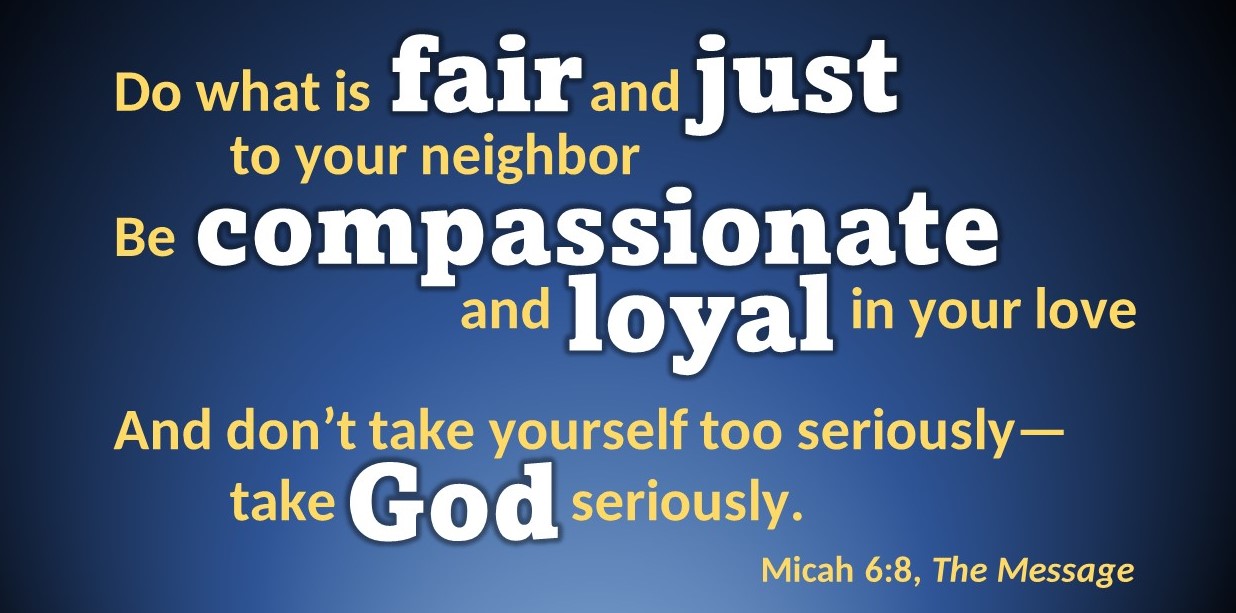
I’m all for us making a commitment to take God more seriously than we take ourselves. My hope, however, is that we would do something more than create new religious habits, as valuable as these habits might be. We need to ask ourselves things like: How would such behaviors help teach me to be a more fair, just, compassionate, and loyal person? How would they help me see and appreciate these qualities in God? And what would these qualities actually look like in my relationships now?
Does that sound like too much? Then start with one relationship. Pray: Lord, to whom would you want me to be more fair, just, compassionate, or loyal? What would this look like? Ask God to reveal his character to you. Imagine embodying that character yourself in that one relationship.
It may not be easy. But hey, you were willing to promise to go to the gym three times a week, right? Give God a chance to develop a different kind of strength in you.
May your new year be blessed!
 Squinting through Fog ("The Fog Blog")