

Dictator. Tyrant. When you hear those words, who comes to mind? History is full of rulers, kings, and emperors who exercised power and maintained control with manipulation and brute force, and the world as a whole has never truly been free of them.
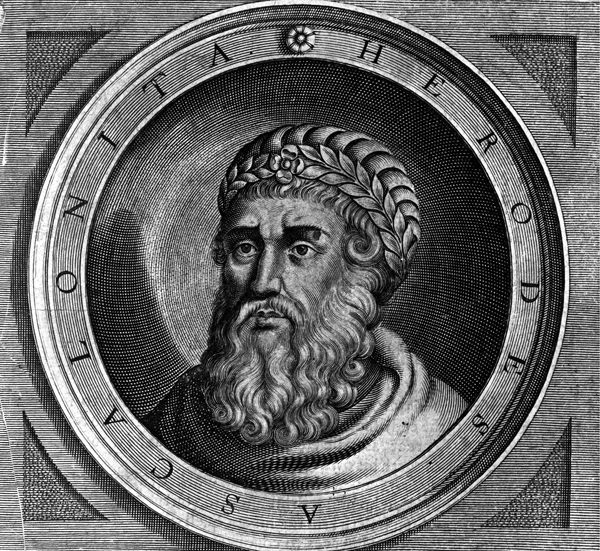
A well-known biblical example would be Herod the Great, the “King Herod” of Matthew’s version of the birth of Jesus. In the years leading up to Jesus’ birth, Herod served as the King of Judea, a title he held only by the pleasure of the Roman senate. The second chapter of Matthew’s gospel paints him as a murderer who killed all the babies and toddlers in the vicinity of Bethlehem. Many historians doubt that this so-called Slaughter of the Innocents really happened. Even if it didn’t, however, history still records the brutal lengths to which Herod was willing to go to preserve his rule.
Today, one might describe him as a bit paranoid — though to be fair, as the saying goes, “Just because you’re paranoid, that doesn’t mean they’re not out to get you.” Herod came to power in a time when Judea was contested territory; he had to fight for his place. Rome liked his style and wanted him there, but that approval was always conditional, and he knew it. The Jewish people he ruled didn’t want him, seeing him as what we would call a “half-breed.” Herod’s role was threatened from different sides, which fed his suspicious nature. He did whatever was needed to stay in power, to the point of assassinating people he saw as threats or rivals — including one of his wives and three of his sons. Matthew’s story suggests that Herod would even execute children if it served his purposes.
So think back to Matthew’s story. Strangers arrived on Herod’s doorstep asking the whereabouts of the one born to be king of the Jews. This was not a mere matter of curiosity. The magi weren’t asking about who pollsters were predicting would be the next president. To Herod, the title “king of the Jews” was his, and his alone, and he would defend it. He understood the import of the magis’ question: they were claiming that the prophesied Messiah had already been born, and they wanted to know where to find him.
And so, of course, did Herod, for his own paranoid reasons. He called together every expert on the Hebrew Scriptures he could find, and asked them where the Messiah was to be born. In response, they quoted the prophet Micah:
But you, Bethlehem, in the land of Judah,
are by no means least among the rulers of Judah;
for out of you will come a ruler
who will shepherd my people Israel. (Matt 2:6, NIV)
Herod’s advisors were quoting Micah a little loosely; the image of the prophesied king as a shepherd doesn’t come until two verses later in Micah. But again, we’ve seen how he and other prophets use the language of both shepherd and king to describe God, as well as the expectations for any earthly king who rules in God’s name. We also connected this to the words of Jesus. For him to claim to be the Good Shepherd in John 10:11 is not just a metaphor; it’s a claim to be the Messiah.
We come then to chapter 5 of the book of Micah, the text quoted by Herod’s advisors. The most relevant verse is verse 2, which reads as follows in the New International Version:
But you, Bethlehem Ephrathah,
though you are small among the clans of Judah,
out of you will come for me
one who will be ruler over Israel,
whose origins are from of old,
from ancient times. (Mic 5:2)
We’ll unpack the context of that verse shortly. Here, I want to return to the matter of how we understand prophecy. In retrospect, it’s easy for us to see that Micah’s oracle refers to Jesus; Matthew has seen to that. But that’s not to say that Micah himself understood this.
Think back to Micah’s prophecy of the restoration of Jerusalem at the beginning of chapter 4. Again, the people who returned from exile and rebuilt Jerusalem did not understand the prophecy to have been fulfilled, and I’ve suggested that we are now looking for the New Jerusalem described in the book of Revelation as the fulfillment of the prophecy. But that doesn’t mean that Micah and John both saw the same thing and just described it differently.
As I suggested all the way back at the beginning of our study, prophecy is not about fortune-telling; it’s a direct and authoritative word from God to his people. Parts of it may indeed involve predictions about the future. But it is first and foremost a word from God — sometimes of encouragement, sometimes of condemnation — given to a particular people in a particular and present time, place, and situation. And that present word also reaches back into the past, assuming a history of relationship, of covenant requirements and promises.
Past, present, and future: all three are bound up in prophecy. And Micah’s prophecy doesn’t have to be “about” Jesus in the way we would normally understand it. In all likelihood, Micah saw the crisis of his own time, delivered the word God gave him to speak, and believed that he was speaking about a human king from the line of David who would arise in the near future to save God’s people from Assyria. He himself would probably have been surprised to see how the story actually unfolded over the centuries.
But none of that prevents Micah’s words from being God’s word. Herod’s advisors didn’t think of Micah’s prophecies as null and void simply because they still hadn’t come to pass centuries later; they were still looking for their fulfillment. When Herod asked his question, Micah’s prophecy about Bethlehem was still the answer. So as we take a closer look at Micah’s words, let’s try to hold the past, present, and future of Micah’s world together. It will deepen our appreciation for what we already take for granted in the New Testament stories we know and love.
 Squinting through Fog ("The Fog Blog")