

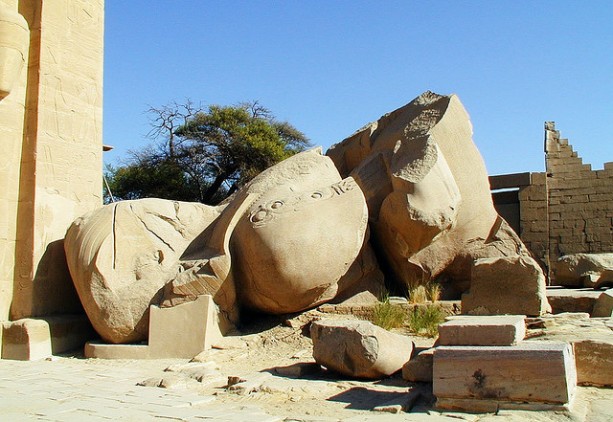
Some of you, in a high school or college English class, read the poem “Ozymandias” by the 19th century Romantic poet Percy Bysshe Shelley. It’s an ode to the arrogance of ancient kings — like the Pharaohs — who boasted of their power and built statues of themselves, statues that eventually crumbled to dust, like the memory of the kings who commissioned them.
But even if you’ve never read the poem, you’re probably familiar with a related saying of Shelley’s that you didn’t know was his: “The rich get richer and the poor get poorer.” That observation was already true long before Shelley’s time, and it’s still true today. Wealth is power; power is opportunity; opportunity makes wealth. Conversely, poverty isn’t just a lack of money, it’s a lack of the power and opportunity that wealthier people take for granted, making it harder for the poor to find ways to climb out of their economic hole.
Here’s a simple example. If I have enough money to keep a specified minimum balance, I can open a no-fee bank account that even pays interest. I know — these days it’s not much interest. But in theory the money grows. Wealth begets wealth for me, and the bank in turn uses my money to make their own money and keep their stockholders happy.
If I can’t keep that minimum balance, however, if I don’t have that kind of capital, I have to pay to keep my money there. In other words, the people who can least afford the monthly fees are the ones who have to pay them.
But hey, that’s just “good business,” right?
Well, yes… but what is “good business” for some, unfortunately, often entails bad consequences for others. Think, for example, of the principle of eminent domain, a government’s legal right to seize private property for what it considers a greater public good. Building a freeway might ease traffic. A shopping mall could create business, taxes, and jobs. And hosting the Summer Olympics? Think of the tourism!
The economic argument may make sense on paper. But whose land is seized? Who is forced to sell their homes, whether they want to or not? Yes, by law, they’re supposed to be paid a “fair” price, but who decides what’s fair for someone who doesn’t want to sell in the first place? Bottom line, the negative consequences of such decisions fall disproportionately into the laps of the poorer people of a community, who are often displaced against their will.

I’m not here to critique eminent domain, nor to join the ranks of the protestors who don’t want the Olympics in their community. But I want us to connect emotionally to what Micah is saying to the people of Jerusalem. God’s people were always meant to be those who cared for the neediest among them. This is explicitly commanded, for example, in Deuteronomy:
There will always be poor people in the land. Therefore I command you to be openhanded toward your fellow Israelites who are poor and needy in your land. (Deut 15:11, NIV)
Throughout the Old Testament, wickedness is characterized by arrogance and the abuse of the powerless, like widows, orphans, and strangers in the land (e.g. Ps 94:4-7). And when Micah preaches against wickedness, he doesn’t do so in the abstract; he knows firsthand what he’s talking about, because he lives among the rural poor. Micah comes to the city of Jerusalem with a word from God, taking aim at the fat cats who are taking advantage of his neighbors and others who can’t stand up to their power:
Woe to those who plan iniquity,
to those who plot evil on their beds!
At morning’s light they carry it out
because it is in their power to do it.
They covet fields and seize them,
and houses, and take them.
They defraud people of their homes,
they rob them of their inheritance. (Mic 2:1-2)
You know the literary stereotypes: sleazy, money-grubbing landlords who take advantage of their tenants; ruthless corporate raiders who ruin their competitors. Micah is describing how some of the people of Jerusalem have become land barons, snapping up other people’s farms and fields for profit, depriving people of their home and heritage. Micah portrays them as lying awake at night, scheming, and jumping out of bed at the crack of dawn to put their plot in motion and claim their next prize.
Such is Micah’s accusation against the people. God is coming in judgment. And what will the judge say? We’ll find out in the next post.
 Squinting through Fog ("The Fog Blog")